
What, After All, Is Calligraphy?
— Understanding the Nature of Chinese Calligraphy Through Brushes with Power

Ren Jingjing (任晶晶)
Richard Curt Kraus (理查德·柯特·克劳斯), in Brushes with Power: Modern Politics and the Chinese Art of Calligraphy (Brushes with Power: Modern Politics and the Chinese Art of Calligraphy《展示权力的毛笔书法——现代政治与中国书法艺术》), does something deliberately conspicuous: he drags calligraphy out of the scholar’s studio and throws it straight back into the arenas of power and social structure. Calligraphy is no longer just a refined object on a desk, no longer only “copying the Two Wangs” and judging brush and ink; it is placed again under the light of modern politics, national symbolism, and mass communication.
The point of the book is not “who writes better,” but “why this particular thing, in Chinese society, has become a language that leads to status, legitimacy, and a governing image.” Kraus keeps pressing the same question: how does calligraphy become the skin of power, a visible trace of authority that can be displayed in public and endlessly reproduced?
If one simply says “calligraphy is a political tool,” the view is again too narrow. Calligraphy can be appropriated by politics because it has always grown out of the bones of culture and everyday life. It is tightly bound to writing itself, bound to poetry, bound to letters and talismans and shop signs and temple couplets and steles and tomb inscriptions. It can decorate space and at the same time testify to identity; it can educate and edify, and at the same time reinforce order.
So it is better to reverse the question. What, in fact, is the nature of Chinese calligraphy? Why is it able to carry so much? Now that computers have become the primary tool, will it lose its “ontological status” and end up as the pastime of a small circle of people?
Looking at the Underlying Structure: Calligraphy Is Not “Writing Beautiful Characters,” but “Writing Order into the Body”
If one takes calligraphy apart down to its lowest level, three hard pieces of bone are hard to avoid.
First, calligraphy is “legible line.” It is not purely painting, because it must be read; it is not purely writing, because it must be looked at. The reader is reading meaning with one eye, and with the other is watching brush force, structure, rhythm, and breath. As the eye moves along the characters, it is decoding semantics and, at the same time, tracking lines left by movement. This “dual channel” gives calligraphy a natural advantage in communication: even if one cannot recognize the characters, one can roughly feel whether it is “steady or not,” “fierce or not,” “loose or not.” From the outset, calligraphy has never been only for “insiders.” It comes with performance built in.
Second, calligraphy is “evidence of bodily movement.” Every turn, press, pause, acceleration, and hesitation is the body leaving traces on paper. The line on the page is not only “pleasing or not”; it looks very much like a public “signature of character.” If the writing is loose, it feels loose; if it is upright, it feels formal; if it is sharp, it feels sharp. This is not mysticism, but a basic human instinct for reading the traces of movement. Seeing a clean, decisive ending stroke, one naturally imagines a steady wrist. Seeing a scatter of wild dry-brush, one easily thinks of someone not eager to submit to rules. Calligraphy thus becomes a way of social judgment: of cultivation, of training, of self-control.
Third, calligraphy is “the product of institutionalized training.” Through a long stretch of history, handwriting was tightly tied to reading, examinations, and office-holding. To write in an “acceptable” way almost meant one had obtained a ticket: it showed that one had received a certain education, belonged to a certain stratum, could enter certain doors. Calligraphy was not just a skill; it was a threshold. It was not merely an art, but a gate in the system.
Once it entered the examination system and bureaucratic machinery, the ability to write became hooked to power. Memorials presented to the emperor, edicts sent to the provinces, the state will carved in stone—all of these depended on brush and ink. The more “proper” the writing, the more it resembled order itself.
Taken together, these three points mean that calligraphy is not just “art,” but a medium that twists together meaning, body, and institution. Kraus’s point of entry is precisely here: that calligraphy can be leaned on by power is no accident; it carries, from the beginning, a threefold capacity—to be read, to be felt, to serve as proof.
What Calligraphy Really Unifies Is the Appearance of Power
To see how calligraphy and politics are entangled, one cannot avoid the moment when Qin Shihuang (秦始皇) unified the script. Script unification was not a minor episode in the history of calligraphy; it was part of the national project. Standardizing measurements, standardizing classics, standardizing bureaucratic documents—all of this had to rest on a standardized writing system. Once the script was unified, norms of writing became part of the order itself: whoever had the authority to decide how characters should be written also had the authority to decide how the world should be recorded.
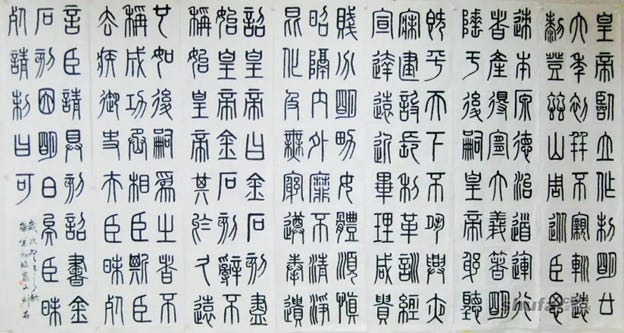
Li Si’s (李斯) inscription on Mount Tai (泰山刻石) therefore matters not only as “a famous hand,” but as “the voice of the state cut into the mountain.” A stele is not written for this or that reader; it is written for “all under heaven.” It turns ruling legitimacy into something visible and tangible.
Here, the key word is “public.” Once it enters steles, edicts, inscriptions, and imperial commands, calligraphy ceases to be merely a private skill on a desk. It becomes the outward shape of public power. The more upright the characters, the more they look like “orthodoxy”; the steadier the brush, the more it looks like “order.” Regimes borrow calligraphy not because it is “refined,” but because it “looks like the system.” When a stele stands, what holds it up from behind is coercive force. But what the front shows the crowd is a set of carefully disciplined strokes and structures. The more regulated the strokes, the more violence disappears from sight.
When speaking of calligraphy and power, a few names come easily to mind: Tang Taizong (唐太宗), Song Huizong (宋徽宗), Mao Zedong (毛泽东). Placed on one line, they show two faces of imperial—or supreme—calligraphy.
One face is genuine feeling. Quite a few rulers really loved writing and truly worked at it. For them, calligraphy meant cultivation, pleasure, and a way of ordering the self. At the moment of picking up the brush, they were not necessarily “calculating power”; they may simply have been spending time with themselves. Tang Taizong discussing calligraphy, Song Huizong inventing his “Slender Gold” script, Mao Zedong writing poems and characters by the pool—these scenes all carry very real personal tastes and moods.
The other face is usefulness. Once the writing of a ruler is brought out, hung up, or reproduced, it immediately enters politics. Plaques, bestowals of characters, stele inscriptions, edicts, seals, dedicatory phrases—if they are public, the writing is no longer “personal expression” but the mark of hierarchy.
Imperial calligraphy enjoys one advantage ordinary calligraphers can never match: it does not need prior “inside recognition,” nor does it need to be tested in the art market. It comes with “the right to circulate.” Once the writing is hung, everyone must look; once it is bestowed, everyone must receive.
A large part of Tang Taizong’s role lay in “using the body of an emperor to organize cultural orthodoxy”: collecting, commenting, promoting—all of these are the ways power lines up cultural history. Song Huizong is even more typical: his personal style is intense, and so is his institutional control. His private taste, magnified through the court, becomes something like “state taste.” By the time we reach Mao Zedong, the public nature of calligraphy is pushed to its modern limit. His handwriting appears in slogans, mastheads, memorial halls, and plaques. The very form of his characters has become a kind of political visual language. It is no longer “a sheet written for so-and-so,” but a public symbol for an entire era.
From Tang Taizong to Mao Zedong, one can see a clear line of extension: on one side, imperial calligraphy is a true hobby; on the other, it is the wrapping paper of power. The two faces often show at once.
Why “Leaders’ Inscriptions” Still Work Today
Many people find contemporary “leaders’ inscriptions” and “celebrity calligraphy” vulgar, yet also hard to escape. Their stubborn vitality lies not in “how well they are written,” but in the way they operate.
At least four traits stand out. The cost is low. A pen, a sheet of paper, and a public occasion are enough to produce a “moment of importance.” Recognition is high. The public may not understand brush technique, but they can usually tell “this is so-and-so’s writing.” In a world flooded with images, “being recognizable” is already a valuable resource. They are easily copied. From door plaques and signboards to brochures, websites, and commemorative items, one piece of writing can be scaled up, scaled down, and reused at will. They are embedded in ritual. Inscriptions never happen in isolation; they cling to ceremonies of conferral, naming, inauguration, commemoration. The “legitimacy” of an institution or project is often confirmed in exactly this small ritual.
So today’s “leaders’ inscriptions” are not merely a few strokes on paper, but a symbolic move of power: using brush and ink to stamp some place or affair as recognized. Those characters at the gate stand there, long-term, as a reminder to everyone who passes under them that this space has once been “seen” and “named” by a certain authority. In this sense, calligraphy continues to play the role of “visible authority.”
Once politics, culture, and daily life are all laid out, the “essence” of calligraphy can be summed up in a very simple sentence: calligraphy is the technique of turning order into visible line. It visualizes the order of language, letting grammar and glyph emerge together. It makes bodily control visible, exposing the steadiness—or shakiness—of the wrist at a glance. It makes social rank visible: who has the right to inscribe a plaque and who does not is obvious the moment characters appear. It makes aesthetic rules visible: what counts as “upright,” what as “slanted,” “dangerous,” or “eccentric,” is demonstrated again and again through countless works.
Politics is only the most conspicuous and forceful user of this entire capacity. Cultural tradition gives calligraphy legitimacy; everyday life gives it broad soil; institutional structures use it to shape themselves. These three do not replace one another; they feed each other.
Kraus’s analysis holds up precisely because he is not fixing on “oddities of this or that dynasty,” but on a structural function of calligraphy as a medium. So long as brush and ink can still write out order, power will keep using them, and society will keep reading them.
Why Calligraphy Persists: Daily Life as Its Quiet Reservoir
Calligraphy has shown such tenacity largely because it long ago seeped into the smallest corners of life, and has never belonged only to court or bureaucracy.
It is linked to poetry. Poems can speak the heart; calligraphy can show the air of a person. When a scroll is unrolled, the words form one layer, the posture of the characters another. A person’s temperament, learning, and bearing are packaged and amplified through this union of poetry and script.
It is linked to letters. A handwritten note is not just the exchange of information; it is also a record of relational warmth. Written fast or slow, how much crossing-out, how wide the margins—all of these sketch the distance between people. Letters are treasured not only because “the content matters,” but because they hold the rhythm of that person’s hand.
It is linked to shop signs. A sign must be memorable, must inspire trust, must look “proper.” The stateliness of regular script, the movement of running script, the gravity of clerical script—they can all be used to shape the face of a storefront. Writing that “looks right” makes the business itself look right; writing that is a mess makes customers uneasy.
It is linked to religious copying. Sutra copying does not aim to “display personality,” but to suppress it. It stresses focus, uprightness, correctness. Every stroke must be steady; every character must be even. The act of copying itself is an exercise in letting the body submit to a certain order. At this point, calligraphy is not only an art; it is also a form of practice.
Put these scenes together and a harder, underlying fact becomes clear: calligraphy has long played a “disciplinary” role. Learning to write from childhood is not only to make future compositions look neat; it is to train patience, posture, and “rule-following.” Tracing red characters line by line, copying model texts over and over, the body is tamed, often without noticing, by a given standard. Good handwriting functions as cultural capital; poor handwriting becomes a kind of pressure. Calligraphy thus becomes a two-edged thing: a cultural resource and a social shackle, a display of cultivation and a mark of class.
The Computer Age: Has Calligraphy Left the Stage?
The keyboard’s displacement of the brush is a change plain to see. Office work, teaching, communication—everything now runs on computers and screens. Writing by hand is no longer the necessary channel for society to function. Many people no longer rely on “having a good hand” to affirm their place in a cultural community.
This does shake calligraphy’s position, but it is not a death sentence. The change looks more like a shift of seat. Part of calligraphy will retreat into art and education. It will look more like painting or music, demanding specialized training and long investment of time. It will become more elite, more academic, and be somewhat removed from most people’s daily routines.
Another part will remain in public symbols and ritual. Festive couplets, school-history steles, museum plaques, inscriptions in religious ceremonies—these scenes still need “the trace of the hand.” Characters spat out by a printer are too flat; they show no sincerity. Handwriting, even with flaws, looks more like a living person being present.
Yet another part will quietly dissolve into design and consumption. Brand logos, packaging fonts, film titles, wayfinding systems—these all borrow, in different ways, from the line logic of calligraphy. They may no longer be called “calligraphy,” but the play of contraction and expansion, turning and pausing, rhythm and weight is still shaping the public eye.
So what we will likely see is not a single, intact “world of calligraphy,” but many scattered fragments: masterpieces in museums; practice sheets in classrooms; plaques in cities; bits of script on products. Calligraphy can no longer monopolize “the act of writing,” but it still presides over “how to write out authority, sincerity, and identity.” In a sense, it is shifting from a “universal skill” toward a “technology of identity and ritual.”
Back to Kraus: Returning “Elegance” to Its Form as Visible Power
The true significance of Brushes with Power lies not only in “adding a piece to calligraphy history,” but in reminding readers not to see calligraphy as a sealed-off elegant room. It is more like a river. In its waters flow lofty aesthetic judgments and naked institutional arrangements, poetic leisure and political struggle, heartfelt personal writing and cold displays of authority.
Chinese calligraphy matters in history not because it is “ancient,” “ethnic,” or “unique,” but because it ties together language, body, order, and power—four things that usually look separate. A single brushstroke falls and is, at once, part of a Chinese character, the afterimage of a bodily motion, a trace of social discipline, and, in many cases, the shell of political legitimacy. Once this is understood, a broader fact becomes easier to see: in China, many things that “look like culture” are at the same time institutional devices; many things that “look like forms of taste” are also skins laid over power and order.
Computers can replace the brush in matters of efficiency, but they struggle to replace that “visible line of authority.” So long as society still needs ritual, still needs distinctions of identity, still needs to turn abstract power and promises into tangible objects, that downward stroke of the brush will not fully leave the stage. Even if it only hangs over a doorway on a plaque, even if it is only stamped onto a commemorative coin, that strip of ink keeps repeating an old truth: brush and ink have never been only about beauty. They have always been writing the system itself.
How long have you practive calligraphy?
A great comment