
Vigorous Clouds in Motion
—Tradition and Innovation in Lu Yankun’s (陆艳坤) Running Script of Li Bai’s (李白) Poetry

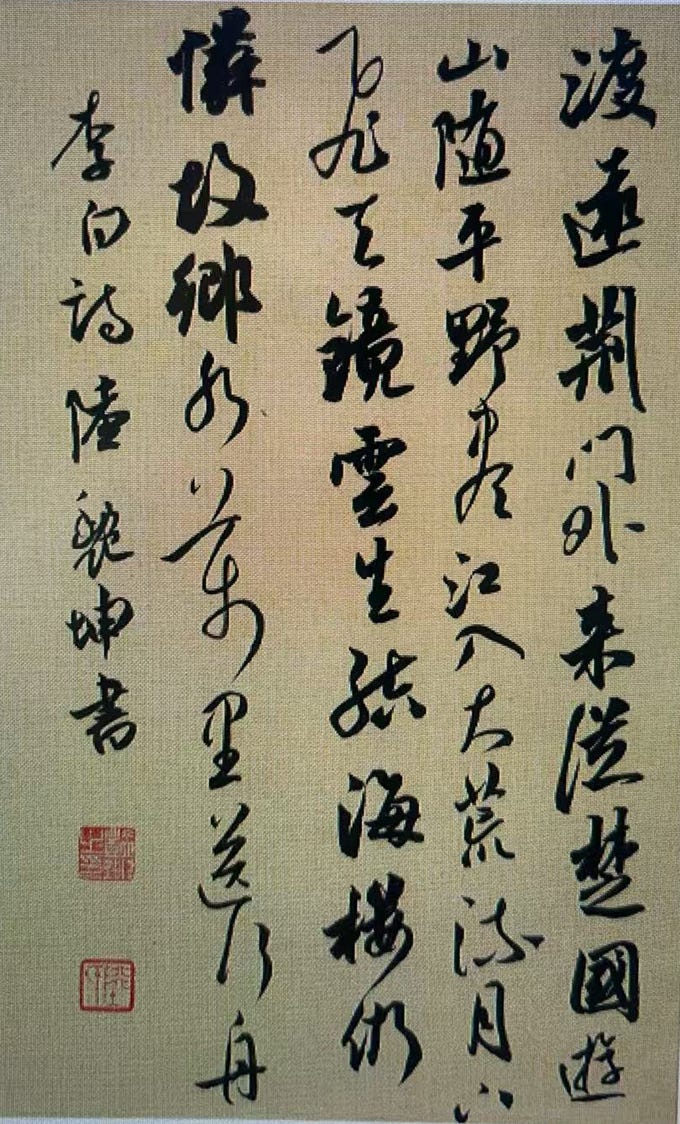
Lu Yankun’s (陆艳坤) running-script rendition of Li Bai’s (李白) poetry reveals both a profound grounding in traditional technique and the unmistakable imprint of his individual style. In his brushwork—from the rhythmic modulation of pressure and lift to the deft pivots of his strokes, from concealed tip to revealed tip, from central-edge contact to side‑edge touch—each movement is both assured and fluid. At the outset of a stroke, he often gathers the brush with composure, the ink seeming to press through the paper; in mid‑stroke, he frequently reins it back lightly, as though channeling clouds and water, sometimes lifting the tip so it wanders freely; and at the close, he employs a weighted pause to both conclude the form and store tension for what follows. This “restrain and release” cadence directly descends from the running‑script tradition of Wang Xizhi (王羲之) and Yan Zhenqing (颜真卿)—strength tempered by grace, vigor laced with elegance.
In his exploration of brush technique, Lu refuses to remain confined by conventional gestures, instead experimenting boldly in the interplay of touch and intent. For instance, in the execution of oblique strokes, he preserves the natural swell and taper yet introduces “mid‑stroke pauses,” allowing the brush to break while the spirit continues—a subtle choreography of interruption and continuity that animates each turn. In horizontal strokes, he deliberately alternates between elongation, compression, and upward flicks, so that the same line moves beyond monotony into moments of buoyancy and moments of latent might, enriching the rhythmic fabric of the text. This nuanced balancing of “break” and “flow,” of “emptiness” and “substance,” speaks to his courage in negotiating tradition and modernity, precision and spontaneity.
When it comes to structure, Lu clearly inherits the spatial and rhythmic sensibilities cultivated by running‑script masters since the Song and Yuan dynasties. His characters often adopt a slightly expanded middle with upper and lower elements in dialogue, the center of gravity subtly shifted so that each glyph radiates outward energy while its crossing strokes and overlaps create internal breathing room—avoiding both chaos and the rigidity of standard script. Across the page, the characters converse in patterns of density and release, alternately tight and lax, letting the eye wander with ease yet find focus at each junction of stroke. Notably, at the intersection of diagonal strokes, he frequently employs “flying white” to produce a play of void and form, granting the composition moments of visual respite—a true fusion of the “bone‑method stroke” and the joyous abandon handed down through the heirs of the “Two Wangs.”
At the same time, he injects his letterforms with a decidedly contemporary aesthetic. Departing from the solemn uniformity prized in traditional running script, he occasionally distorts radicals—stretching, compressing, or tilting them—to create gentle asymmetries. He also adjusts the angles between horizontal and vertical strokes, so that the once‑steady grid acquires flickers of liveliness and playful irregularity. This dialogue between “balance” and “imbalance” reveals his dual inquiry into formality and personal rhythm: he honors the fundamental rules of running script while deliberately foregrounding his own writing cadence.
In his overall layout, Lu adheres to the classical principle of “measured variation,” orchestrating density and openness with evident discrimination. The vertical flow of the scroll remains upright, yet the inter‑line spacing neither rigidly equidistant nor so haphazard as to confound the eye. He breaks the poem into several lines of roughly equal length, yet achieves a delicate conversation between vertical white space and horizontal ink density: generous margins at the start of each line invite the viewer in; graceful tapering at each line’s end forms a soft transition to the next; the gaps between lines both echo the poem’s own rhythms and offer visual breathing room. This careful arrangement honors the verse’s internal cadence and sustains the reader’s engagement and aesthetic anticipation.
Of particular note are his deliberate moments of “flying white” and purposeful line breaks—moves that at first seem spontaneous but in truth guide the viewing path. When characters crowd the page, visual fatigue can set in; by suddenly slowing the flow or widening a gap—akin to a musical rest—he grants the eye a moment to regroup, sharpening attention for the line that follows. These rhythmical pivots between continuity and interruption embody the personal innovation he brings to time‑honored layout principles.
Yet there remains room for further refinement. Though his ink application is admirably clear and moist, his heavier passages can feel slightly static compared to the transparency of his lighter washes. By heightening the contrast between dense and pale tones, or by layering transitions between bold strokes and “flying white,” he could amplify the dynamism and depth of his brushwork. Similarly, his experimental asymmetries are commendable, but might gain richer cultural resonance if they more directly echoed the emotional tone or poetic rhythm of each line—allowing shifts in radical form to mirror the verse’s sentiment.
Overall, Lu Yankun’s running‑script masterpiece strikes a rare balance between heritage and innovation. He synthesizes the brush‑structure principles and layout strategies perfected by masters such as Wang Xizhi (王羲之), Yan Zhenqing (颜真卿), and Zhao Mengfu (赵孟頫) while boldly reimagining stroke weight, spatial tension, and sequence composition. The result is a script that feels both restrained and vibrant, measured yet alive. Looking ahead, were he to embrace even greater daring in tonal contrast, deepen his structural experiments, and extend his calibrated expansiveness into more liberated spatial arrangements, his work will undoubtedly carve a new realm atop the edifice of tradition.