Transmuting Ink into Life
— Reflections on Idle Talks on Calligraphy

。Ren Jingjing (任晶晶)
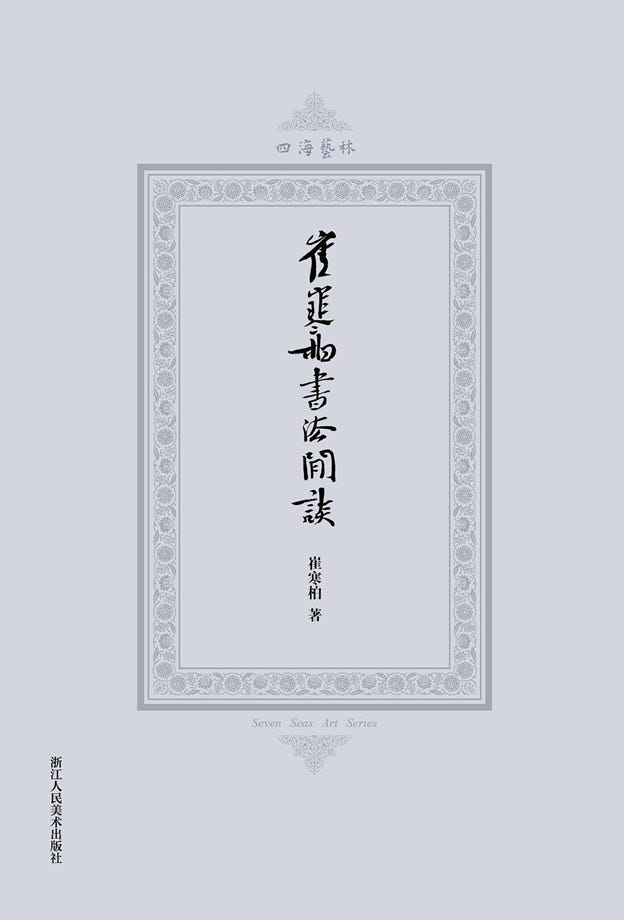
“Write long enough and you will overhear your own temperament,” Cui Hanbo (崔寒柏) warns at the close of Idle Talks on Calligraphy (《崔寒柏书法闲谈》). What might have been a collection of gnomic dicta is recast here as an invitation. For the novice, the book lays a corridor from textual illiteracy to bodily literacy; for the seasoned scribe, it offers a finely tuned antenna that translates the static of time zones, hashtags, and exhibition politics into fresh rhythms on silk. Cui’s “shortcut” is not an escape from labor but a compass, guiding the wrist toward the pulse of ancestors and contemporaries alike—an exit, at last, from the labyrinth of textbook pedantry into a sudden clearing.
After finishing Idle Talks on Calligraphy, I felt an almost comical jolt—“turning my head, the brush was already in my hand.” Under Cui’s murmuring guidance, a mute sheet of xuan paper seemed to quicken with its own pulse, demanding ink. Across forty-one short essays distilled from three decades at the ink-stone, Cui sets a hidden architecture: an anecdote or quip to split the curtain, a sly exposition of method, and a final pivot toward “how to live this stroke in the world.” The prose steeps like tea brought just to the boil—aroma released, flame held low. For the long-dormant beginner, the effect is devastating: calligraphy descends from its bronze altar and becomes an old chair, ready whenever one cares to sit.
Where competing primers parcel their lessons—origins, genealogies, brushwork, composition, ink—until the initiate is lost beneath terminology, Cui digs downward rather than spreading wide. “Masters,” “Model Books,” and “Practice” are drilled through the same shaft until personality, stele-grown musculature, and contemporary unease meet in the well’s cool bottom. Discussing Zhong Yao (钟繇), he forgoes chronology to seize on the inner-pressured center stroke, cracking open the aesthetic of “fleshly yet boned” script; in the next breath he diagnoses the modern student whose running script has been whittled to bare cartilage, yoking past and present on a single line of inquiry. History, thus animated, stops reading like desiccated parchment and starts behaving like an old friend met at midnight.
Compared with Deng Sanmu’s (邓散木) venerable Tutorial in Regular Script (《楷书入门》) or Qiu Zhenzhong’s (邱振中) academic Foundations of Calligraphy (《书法学》), Cui privileges experience over exegesis. Deng supplies austere line diagrams; Qiu marshals semiotic theory; Cui threads technique between campfire jokes. His volume hovers between workbook and philosophical tract—reflective enough to provoke thought, practical enough to stain the sleeve.
Barbs and deadpan abound; Douban reviewers have dubbed the book a “snarky Shishuo Xinyu.” Confronted with blank paper, most beginners dread the irreversibility of ink—one slip and the sheet is ruined. Cui punctures those nerves with an image of a master “beating a Ming sideboard with a poker,” proof that even giants know awkwardness. Humor doubles as pedagogy: the “scorched-damp-parched-moist” spectrum of ink becomes a matter of kitchen heat; the rise-dip-twist rhythm of a stroke mirrors the cadence of braking a car; the dialectic of hidden and revealed bone recalls the flex-and-release of an ankle mid-run. What once felt esoteric collapses into daily breath.
For absolute beginners, Cui offers a triptych of initiations. First, “salute the dead”: progress through the three great running scripts—Wang Xizhi (王羲之) for bone, Yan Zhenqing (颜真卿) for weight, Su Shi (苏轼) for breath. Second, “spar the living”: forty minutes a day, with a weekly scan of the character yong (永) to chart skewed angles and sagging weight, phone snaps replacing gym mirrors. Third, “interrogate the self”: once structure stabilizes, jettison the model, write grocery lists and diaries, let the script betray temperament, then revise whatever offends the eye. Reviewers speak of a “seven-day effect”: by week’s end one sees drifting centers; by the second, a voluntary deceleration; by the third, the twinning of calligraphy with respiration—the real shortcut from ignorance to insight.
Cui is merciless toward three “false shortcuts” peddled by the marketplace: exhibition mimicry—aping the freakish bravura prized by juries; tool fetishism—believing rare wolf hair compensates for jittery nerves; speed worship—confusing flailing motion for structural integrity. He counters with Yan Zhenqing’s Draft of a Requiem for Nephew (《祭侄文稿》): its blazing energy rests on stone-solid bone. The remedy is a return to tempo—slow copying reveals the “submerged pulse,” micro-overlaps displacing theatrical swipes, insulating the student from the contagion of “ugly calligraphy” and saving years of detour.
The book’s most moving undercurrent is its claim that writing and living are indivisible. “Those who write slowly have slower heartbeats,” Cui notes, likening practice to seated meditation: breath adjusted, mind settled, energy discharged in an instant of wrist. Clips of this aphorism, sound-tracked and looped on e-commerce streams, draw comments from office workers who say brush drills have tempered their reactions to managers’ commands—“press, then lift,” trading haste for clarity. Calligraphy becomes a metronome for life. “If a poster or love letter can show its pulse,” Cui concludes, “then calligraphy has already saved your life.”
On marrying classical jade to modern steel, Cui coins the formula “ancient bone, modern flesh.” First erect Tang-style scaffolding—verticals as columns, horizontals as beams—then import Bauhaus asymmetry or the negative-space instincts of photography so that ink and void pursue one another. An award-winning scroll of his, he notes, grafts Yan’s forms onto a cinematic split frame: tradition and modernity striking “a resonant clang.” The lesson for young escapees of copybook purgatory is clear: root first, twist later; coil energy before flipping; aerial acrobatics demand a launchpad.
Reception is not uniformly rapturous. A Douban score of 7.4 flags reservations: some find Cui’s fire aimed at “ugly calligraphy” too ferocious; others lament the absence of step-by-step stroke diagrams. Yet that, perhaps, is the point: the book is kindle, not conveyor belt. Real practice still requires dawn visits to stele forests and ink shops; Cui merely strikes the bell that invites readers through the gate.
What the book finally offers is a ramp, not a cliff. The stones were laid by elders; the footlights are wired by Cui. Beginners know where to place a first step, and midway they can look up to see their own pulse mirrored in the cadence of the brush. The moment one ceases fretting over resemblance and begins to ask whether a stroke is honest, one has entered Cui’s “narrow door” from method to way. Calligraphy may never pay the rent, but in cacophonous times it can leave three inches of cool shade.