
Reflections on the Phenomenon of “Ugly Calligraphy” in Contemporary China
对当代中国丑书现象的思考
By Li Zhen (李臻)
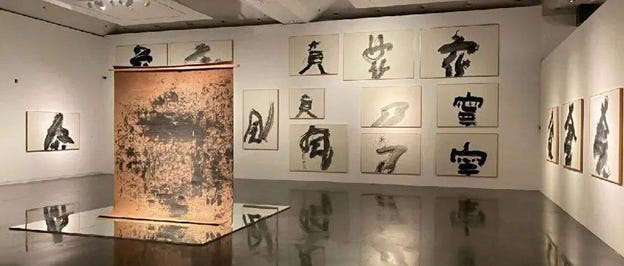
【Editor’s Note: The rise of “ugly calligraphy” (“choushu” 丑书) in contemporary China marks a departure from the rigorous aesthetic traditions of Chinese calligraphy. This trend distorts strokes and structure in the name of individuality or innovation but often lacks the technical mastery, balance, and artistic spirit that define the art form. Traditional calligraphy, from the oracle bone script to the masterpieces of the Tang, Song, and later dynasties, has always upheld disciplined brushwork, structural harmony, and expressive depth. By prioritizing shock value over artistic integrity, “ugly calligraphy” undermines the aesthetics of traditional ink art, misleading public taste and diluting artistic standards. Market forces and media hype exacerbate its spread, favoring novelty over skill. As it gains traction in exhibitions and commerce, this phenomenon risks eroding the cultural legacy of Chinese calligraphy. True innovation stems from deep-rooted tradition, not sensationalism, and calligraphy must retain its refined spirit rather than devolve into a transient spectacle.】
Contemporary China has seen the widespread rise of what is often referred to as “ugly calligraphy” (“choushu” 丑书): a trend that, in both the creation and circulation of calligraphy, deliberately pursues the bizarre and the grotesque. At times, it manifests in warped, misshapen strokes, all for the sake of proclaiming some notion of individuality or “innovation.” In doing so, it disregards the rigorous demands that traditional calligraphy places on brushwork, structure, composition, and artistic mood. What was once a venerated art championing beauty and elegance is thus twisted into a crude, frenzied form of handwriting.
Continuity and Fracture with the Traditional Lineage
Chinese calligraphy boasts a long history, traceable to the oracle bones and bronze inscriptions of antiquity. In those eras, writing was largely practical or ceremonial, with forms that could be solemnly precise but also possessed an emerging sense of aesthetic value. By the Qin and Han dynasties, the Small Seal Script and the Clerical Script had matured, allowing Chinese characters to develop under clear rules. During this period, calligraphy placed a premium on the refinement and beauty of individual strokes and shapes, laying the conceptual groundwork that “the character itself is form, and form conveys the spirit.”
In the Wei and Jin dynasties, the literati class sought refuge from political strife and the confines of Confucian propriety, igniting an extraordinary efflorescence in literature and the arts. It was in this context that calligraphy gained a heightened sense of self-awareness as an art. Wang Xizhi (王羲之) and his son Wang Xianzhi (王献之) elevated running script and cursive script to unprecedented heights, embracing the natural, airy, and dynamically expressive. The rules and aesthetics fashioned in this era opened the door to the pen-and-ink artistry that followed, and they laid the very foundation of Chinese calligraphy.
During the Tang dynasty, regular script reigned supreme, as exemplified by masters such as Ouyang Xun (欧阳询), Yan Zhenqing (颜真卿), and Liu Gongquan (柳公权). Their work epitomized grandeur, stateliness, and exacting precision. In the Song dynasty, building upon Tang-dynasty norms, individual aesthetic taste grew more pronounced, heralding the emergence of Su Shi (苏轼), Huang Tingjian (黄庭坚), Mi Fu (米芾), and Cai Xiang (蔡襄), sometimes referred to as the “Song Four Masters” (宋四家). They strove for a literati sensibility and a spirited vitality in brush and ink, shifting from a focus on “the beauty of rules” to “the beauty of inner meaning.” From then on, calligraphy was seen not merely as a technique but as an outward reflection of personal cultivation and character.
In the Yuan, Ming, and Qing dynasties, calligraphic styles grew even more diverse. There were revivalists, led by Zhao Mengfu (赵孟頫), who looked to the past, as well as distinctly personal innovators, such as Xu Wei (徐渭) and Wang Duo (王铎). Despite stylistic disparities, most practitioners continued to recognize the brush technique as the bedrock, holding firmly to the principle of “learning from the best” while honoring tradition. In so doing, they placed a premium on technical skill, structural composition, and the authentic lineage of ink work.
After the founding of the Republic of China, Western influences became increasingly widespread, and art education took many forms. Some calligraphers sought to break established constraints by incorporating new materials and new formats, while others called for a return to the classical spirit of the Jin and Tang dynasties as a means of preserving tradition. In this context, genuine innovation often rested on a profound understanding of tradition or the fusion of modern aesthetics with time-honored techniques. In the long course of calligraphic evolution, the integration of technique, culture, and ideas has never ceased—a reason calligraphy has been able to endure for millennia.
A look back at the history of calligraphy shows that “ugly calligraphy,” if it is merely an extreme distortion of brush and form, devoid of support from the orthodox tradition, tends to resemble a tree with no roots or water with no source. Pursuing nothing but an odd or outlandish appearance at the expense of brush technique, structure, composition, and artistic mood inevitably leads to a scattering of forms without a unifying spirit. Unsurprisingly, such works cannot secure a lasting foothold in the art-historical record.
Departing from “Beauty”: A Misguided Aesthetic
At its core, calligraphy’s aesthetics hinge on a harmony of brush and ink, balanced composition, fluid energy, and the fusion of the spiritual and the tangible. Since the Wei and Jin dynasties, the Chinese arts have generally striven for an ideal of “vital resonance” and “harmonious balance.” Factors such as the length, thickness, and shape of each stroke; the spacing of the characters; and the subtle interplay of ink density or dryness all must interact with the calligrapher’s frame of mind and the character’s inherent meaning.
Contemporary “ugly calligraphy” often aggressively warps strokes and randomly exaggerates a character’s structure. It may haphazardly splice together different script types or resort to a kind of graffiti-like effect, neglecting fundamental brushwork and disregarding the compositional flow among the characters. In place of traditional calligraphy’s quest for beauty and meaning, it offers only shock value: a jumbled impression of wildness, chaos, and oddity. The work may earn attention for its twisted forms, but it loses the soul of calligraphy as an art of “conveying spirit through form.”
Some creators of “ugly calligraphy” tout “individuality” or “innovation” as justifications, mistakenly equating the outré with the fashionable and the weird with the artistically meritorious. But genuine innovation is never a straightforward rejection or negation of tradition and beauty. Rather, it navigates a subtle balance between “staying true” and “pushing boundaries.” Many examples of “ugly calligraphy” are in fact monotonous and crudely frenetic. They do not express a truly personal language of brush and ink; instead, they cater to a market intrigued by novelty or fueled by sensationalism.
When “ugly calligraphy” is frequently highlighted in the media, at exhibitions, or in certain marketplaces, it can mislead public taste. Some younger enthusiasts or novices, lacking a firm grounding under the guidance of a master, may chase after this so-called “cool” style purely on impulse or imitation. In the end, it prompts a collective decline in the appreciation of calligraphy, rendering society less capable of discerning what makes calligraphy genuinely beautiful.
Polluting a Culture of Refinement and Elegance
“Cultural pollution” refers to an adverse impact on an existing cultural ecosystem—eroding its values, communication channels, and aesthetic criteria. In its approach to creativity, its aesthetic leanings, and its effect on society, “ugly calligraphy” can become just such a source of contamination. By resorting to mere sensationalism, it supplants the understated, lofty spirit of calligraphy with crudity, undermining people’s respect and recognition of traditional art.
Chinese calligraphy enjoys the reputation of being a “national treasure” precisely because it possesses a complete theoretical, technical, and aesthetic system, augmented by centuries’ worth of outstanding works. The spread of “ugly calligraphy” not only distorts public perception of what a “calligrapher” truly is—it also drowns out dedicated professionals who painstakingly study and practice authentic calligraphic methods. Their efforts often go unrecognized amidst the clamor, and professionalism is undervalued, inadvertently encouraging those who achieve short-term fame through outlandish stunts or shock tactics.
Today, commercial undertakings such as calligraphy exhibitions, auctions, or corporate commissions may rely on “ugly calligraphy” to stir debate or draw publicity. If we allow this hype to dictate artistic value, such works will only proliferate, aided by market capital, and generate a negative demonstration effect. Over time, genuine artistic creation and cultural activities may find themselves trapped in a vicious cycle of “bad money driving out good,” where mediocrity overshadows true merit.
In principle, calligraphy should serve as one of the pathways through which people experience beauty and elevate the spirit. Yet, when “ugly calligraphy” dominates, society becomes more prone to mocking traditional values, underestimating the importance of solid technique, and praising only the sensational. Gradually, our ability to judge cultural merit and aesthetic worth declines, creating a restless, utilitarian cultural climate.
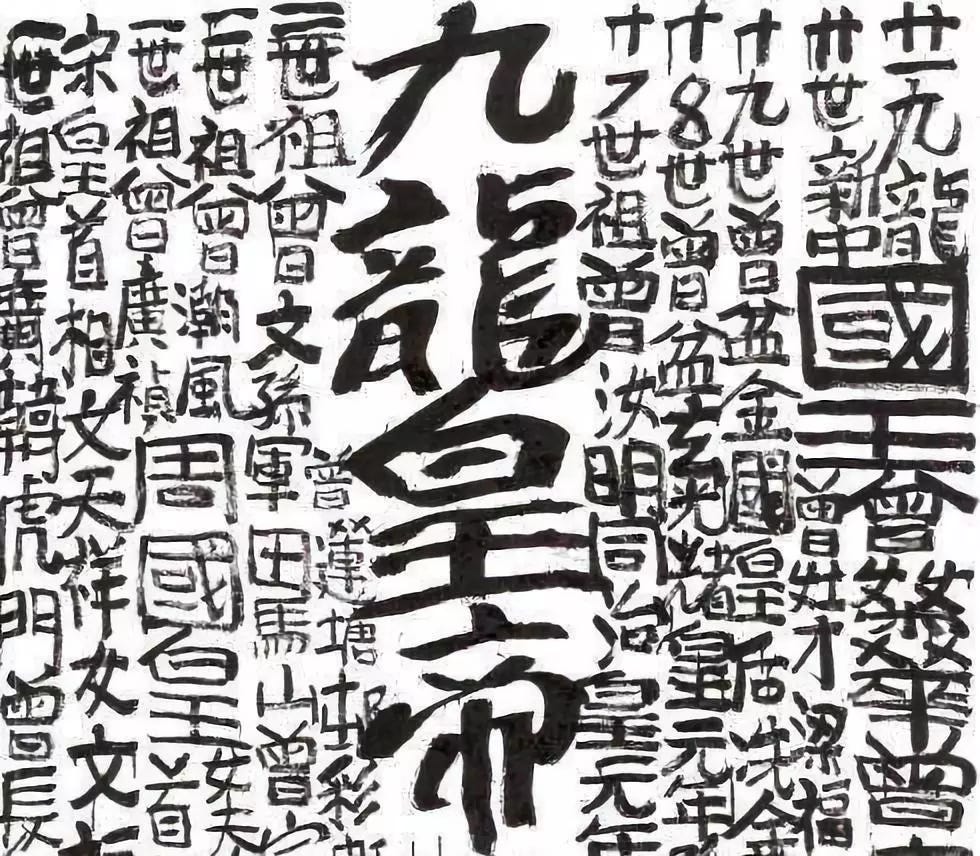
The reason “ugly calligraphy” demands our attention lies not merely in its shock value or novelty but in its potential to inflict damage on calligraphy as a cherished art form, distorting the broader social aesthetic and cultural atmosphere. Looking back at the evolution of calligraphy—from the era of the “Two Wangs” (二王) to the great masters of the Tang and Song dynasties, and onward to celebrated figures of the Yuan, Ming, and Qing—it is evident that all placed emphasis on skillful brushwork, inner energy, and respect for the beauty of established forms and genuine meaning. True innovation has always been deeply rooted in the fertile soil of tradition rather than in sensational oddities calculated to grab attention. Aesthetically, “ugly calligraphy” replaces harmony with deliberate contortion and supplants structural beauty with jumbled heaps, robbing viewers of the pleasure and enlightenment that calligraphy can offer. On a social level, it diminishes calligraphy’s capacity to inspire and ennoble, fueling trends of impetuousness and quick-fix gratification. From a cultural perspective, it acts like a pollutant, derailing the transmission and reverence of outstanding Chinese artistic traditions, and tilts the market’s attention toward gimmicks at the expense of genuine artistic substance.
This translation is an independent yet well-intentioned effort by the China Thought Express editorial team to bridge ideas between the Chinese and English-speaking worlds.