
Humor in Calligraphy
—On the Playfulness of Running Script and the Structural Wit in Wang Duo’s Inscription of Mi Fu’s “Poem Written Aboard a Boat on the Wu River”

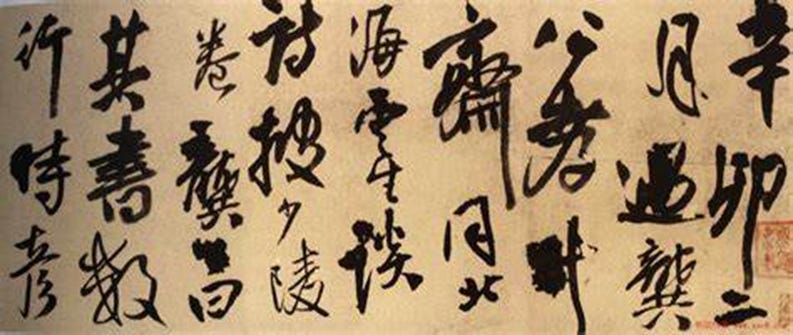
Ren Jingjing
From Mi Fu to Wang Duo
The title tells us that this is an inscription written for Mi Fu’s “Poem Written Aboard a Boat on the Wu River” (Wujiang Zhouzhong Shi, 《吴江舟中诗》). That means Mi Fu (米芾) cannot be avoided. The moment many people see Wang Duo (王铎), and see this kind of plunging, slanting, off-center movement, they rush to say that he was “learning from Mi.” Mi Fu was the one who played most brilliantly, and changed most brilliantly, along this path of what may be called “humor.” Many of his characters refuse to behave. Where a form ought to sit level, he lets it tilt a little. Where it ought to feel full, he deliberately leaves a bit of emptiness. Where it ought to settle firmly, he makes it sway first. There is a strong sense of play in this. In Mi Fu’s running script, for example, the center of gravity often does not sit rigidly in the middle. It slips lightly to one side, then is drawn back by the brush momentum and by the next character. That motion—leaning away, then being pulled back—is itself a kind of brush intelligence. It is like a very clever speaker who never moves in a straight line, who always turns slightly aside first, makes you pause, and only then leads you back. In calligraphy, humor often hides inside exactly this process: imbalance first, recovery after.
In Mi Fu’s so-called “brushed writing,” what is strongest is its spirit. It has a quick, unbound adaptability. It has slanted forms and rapid brushwork. Wang Duo clearly absorbed much from Mi’s writing, especially that refusal to remain square and settled, that diagonal lift that makes characters come alive. But Wang Duo is not simply an extension of Mi Fu. He is heavier than Mi, harsher than Mi, and more transformed by what came later.
Wang Duo plainly understood Mi Fu, and understood him deeply. But he was not Mi Fu’s duplicate. What Mi Fu gave him was a way of being alive on the page, not a set of outward templates. Once it reaches Wang Duo, Mi Fu’s lightness becomes weightier, Mi Fu’s quickness grows denser, and that elegant wit in Mi’s writing is pulled into the tense historical fate of a man from the late Ming. The Princeton University Art Museum, in discussing Wang Duo, stresses that he worked for years from classical model texts, especially within the Two Wangs tradition, and turned that classical elegance into a highly inventive language of his own. That point matters. Wang Duo did not study one lineage alone. He took in a whole range of classical masters, then broke out from inside them. Mi Fu was only one key spark in that chain.
Mi Fu’s sense of fun is mostly the liveliness of a literatus. It carries a bit of arrogance, a bit of fastidiousness, and a confidence that says, “I know what I am looking at.” Wang Duo is different. He enlarges that liveliness, and also deepens it. His writing has an added layer of wet ink, an added layer of torsion, and a stronger sense of pressure on the surface of the paper. So when both men write on the slant, Mi Fu feels more like an immortal in flight, while Wang Duo feels more like a drunken general. When both men are clever, Mi Fu feels more like lucid conversation, while Wang Duo feels more like wind charged with electricity.
So although this inscription takes Mi Fu’s poem as its point of departure, its real temperament is unmistakably Wang Duo’s own. It is not speaking on Mi Fu’s behalf. It uses Mi Fu as an entrance, then drives hard into its own structural taste and formal personality.
When people talk about Wang Duo, many first think of “large,” “dangerous,” “like strewn rocks,” “swelling ink in motion.” They think of that force that comes down in one sweep and nearly overturns the page. But if one sees only that layer, one is still seeing too little. What is good in Wang Duo lies not only in force, but in intelligence; not only in gravity, but in wit. Put another way, his writing contains something that has rarely been discussed with enough seriousness: humor.
The humor meant here is not joking, not frivolity, and not writing characters into grotesque shapes. It is a high level of judgment in writing. It allows a character to survive even in danger, to remain refined even in strangeness, and to stay measured even in exaggeration. This work, Wang Duo’s Inscription for Mi Fu’s “Poem Written Aboard a Boat on the Wu River”, shows that very clearly. Even from the few lines visible in the screenshot, it is already clear that Wang Duo is not simply asking, “Whom do I resemble?” He is using Mi Fu’s poem, and using the channel of running script, to release his own temperament—knotted yet alive, lofty yet playful—layer by layer.
What is most moving in this piece is not that every character is beautiful, nor that every stroke is perfectly exact. It is that the work as a whole has an air of speech. It does not put on airs. It does not sit stiffly. It is not even afraid of a little deliberate skew, a little deliberate tilt, a little deliberate compression. That is why it lives.
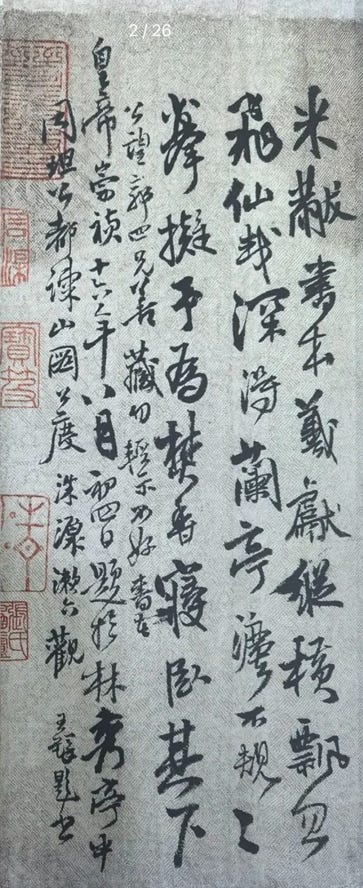
Wang Duo’s Humor Lies in Structure
It is easy to go astray when discussing humor in calligraphy. The moment many people hear the phrase “sense of humor,” they think about content. They ask whether the text itself is playful, or whether the calligrapher’s personality was witty. But when the issue is brought back to calligraphy itself, humor shows itself first in structure. That means how a character stands, how it tilts, how it is made deliberately unstable and yet does not fall.
What Wang Duo does best is this: he knows how to make a character structurally off balance, and then save it at the very last instant. This way of writing carries a kind of sharpness in itself. It is like a person speaking who deliberately lets the line of thought turn aside first, makes you start, and then lands it securely. That effect—almost going wrong, then coming right—is calligraphic humor.
In this work, the scale of the characters, the left-right weighting, and the opening and closing of upper and lower parts are all far from conventional. The characters are not lined up neatly like ranks of soldiers. They are more like a group of figures, each with its own personality, each glancing at the others, yielding to them, or jostling for room. Once that happens, they are no longer dead characters. They are living characters. They are no longer standard units. They become individuals with a temper of their own.
The danger in the character xi (羲), as you noted, is observed exactly right. This character shows both Wang Duo’s mischievousness and his real mastery. Xi is difficult to write to begin with. The right side is dense and complicated, while the left side is weak in support. If one is careless, it comes apart. Wang Duo refuses to write it evenly. Instead, he deliberately pulls the left and right apart and makes the contrast in scale very strong. The left side looks like a slanting brace. The right side looks like a heavy cluster of energy, about to drop but not quite dropping. The character looks precarious, a little shaky, even a little theatrical in the way it flaunts danger. But if one looks closely, it becomes clear that this is not recklessness. Its hidden axis is still there. Its center of gravity has not really slipped away. The danger is real, and so is the control. Humor in calligraphy often appears exactly here: he could have written it obediently, but instead he writes as if he were walking a tightrope. The viewer grows nervous for him, while he has already calculated everything in advance.
The traditional characters in this work are especially interesting. Characters such as Fu (芾), guan (观), fen (焚), wo (卧), fa (法), and xian (献) are not spread out step by step in a regular way. Each one is stretched into an exaggerated internal tension of its own. Wang Duo is never afraid of partial loss of control when handling complex characters. Quite the opposite. He often makes one part swell, another contract, one corner crowd in tightly, one sweep run unusually long. The result is that a character no longer functions as a mere unit of recognition. It becomes a form with expression.
Take Fu (芾). Written conventionally, it easily goes flat. Wang Duo usually refuses to let it go flat. He often writes the left side so that it spreads and jumps, giving the whole character a sense of weight on the left and lightness on the right. Once that feeling appears, the character has drama. It is like someone who ought to be sitting upright, yet suddenly leans forward just a little. The motion is small, but it is vivid.
The character guan (观) works the same way. The right side is already complex. If it is written too evenly, it turns dull. Wang Duo often pulls one component open on purpose, or squeezes one part off center, so that the right side arrives at a condition of being almost dispersed, but not quite. The character becomes nimble and even a little sly. It is not obedient, but neither is it out of hand. It is a way of tampering inside the rules.
The characters fen (焚), wo (卧), fa (法), and xian (献) show even more clearly that Wang Duo does not handle complex characters by “filling them up,” but by “bringing them to life.” That matters. Many people, when writing dense traditional forms, end up just piling on strokes, as if fitting parts into a grid. Wang Duo does not. He knows that what complex characters fear most is uniformity. Once uniformity enters, the character goes dull. So he works precisely against that. In some places he compresses hard, as if deliberately stopping the air from passing through. In other places he suddenly opens things out, like a window left on a crack. Between contraction and release, the character develops breath, expression, and humor.
Humor is not an ornament. It is a way of keeping complexity from dying. Wang Duo understood that very deeply.
Exaggeration Is Where the Smile in This Work Lives
If one asks which kind of change in this work most directly creates its sense of play, the answer is still exaggeration in upper-and-lower structure. For examples—shen (深), lan (兰), and de (得)—are exactly the right set to point to. These are the kinds of characters in which Wang Duo’s structural play is easiest to see.
The character shen (深) is easy to write literally, and easy to write dully. Its left and right parts are already complicated. If the upper and lower parts are then also treated too evenly, the whole character sinks. Wang Duo often makes one very clear move here: either he lifts the upper section very high, or he presses the lower section very low, so that a strong difference opens inside the character. Once that difference appears, the character no longer looks as if it were simply written. It looks assembled—its upper part suspended, its lower part hanging, and the middle barely holding the two together. This feeling, dangerous yet slippery, slippery yet stable, is very much Wang Duo’s own.
The character lan (兰) is also wonderfully handled. If it is written too squarely, it becomes too elegant, and that elegance empties out. Wang Duo will not allow that. He often makes the upper part light and nimble, and the lower part broad and stretched—or does the reverse, pushing the lower section outward so that the whole character acquires a disproportion that is oddly charming. One may feel that it is “a little too much,” but that “too much” is precisely what saves it from being merely decorous and gives it a spark of wit.
The character de (得) is even more typical. It has many components and a complex internal relation. The hardest thing is to keep it clear without making it stiff. Wang Duo often exaggerates the proportions between upper and lower parts so that the character feels a little top-light and bottom-heavy, or tight above and loose below. Once that happens, the character takes on motion. It is like a person walking while turning back to answer someone. The pleasure here is not ornament. It is a mischievousness in rhythm.
In the end, humor in calligraphy is a matter of rhythm. It is not about what is written, but how it is written; not about semantic meaning, but about the posture of the character. In Wang Duo’s handling of these upper-and-lower forms, one comes very close to a kind of dangerousness with a smile in it. Not an open laugh, but a secret smile in brush and ink.
At this point one has to answer a basic question: why does exaggeration look affected in some hands, but convincing in Wang Duo’s?
The answer is simple enough. His exaggeration is not floating on the surface. It is built on bone structure.
The term gufa, or “bone method,” has become a bit overused today. The moment many people hear it, they think only of strong brush force. That is not enough. Bone method matters more as an internal relation. A character stands not because one stroke is especially heavy, but because a few key supports inside it have been built into place. However much Wang Duo exaggerates, he never loses that base.
In this work, many characters look crooked, shaky, ready to tumble out. Yet the true movement of the line, the hidden axes, and the handoff of force from stroke to stroke are all still there. Each character may have its own strange look, yet it still submits to the rhythm of the line. Each line may rise and fall, yet the whole work is still carried by one continuous current of energy. That is not casual eccentricity. It is the deliberate invention of a master.
And because bone structure supports it, the exaggeration never turns oily, coquettish, or shallow. It is interesting, but not superficial. It has a smile in it, but not a slippery one. It is like someone who has seen great occasions and deliberately tells a playful line, while the weight behind it still holds.
What Lies Behind Wang Duo’s Humor
Still, if one sees this piece only as “fun,” that too is not enough. Wang Duo’s sense of play was never a purely light one. There is always in his writing something of the late Ming remnant spirit, something shaped by the pressure of an age breaking apart. That is to say, his exaggeration is not only an aesthetic choice. It is also an outward form of inward structure.
Wang Duo lived through the Ming-Qing dynastic transition. That is the large historical background. When an age falls out of order, identities become unstable, values are rearranged. Even a man of great talent cannot live securely inside pure art alone. Under such conditions, calligraphy grows a very particular quality: outward flight, inward tension; outward extravagance, inward bitterness.
This inscription has that taste. It is not a mourning hand and not a hand of lament, yet it is no mere work of elegant ease either. There is in it a kind of alertness that feels as if it were written for the self to see. The characters are a little slippery, a little sly, a little deliberately reckless, but behind that lies a pressure that refuses to flatten out. That pressure keeps the humor from becoming light. There is a touch of self-mockery in it, and also a kind of grim endurance, and also a stubborn streak that says, “I will write it this way.”
That lifts it above ordinary playfulness. High humor is rarely pure cheer. More often, there is some sadness behind it. Wang Duo is exactly like that.
Today, when people talk about calligraphy, they often like to speak of “bearing,” “tradition,” and “discipline.” All of that is right. But one thing is often overlooked, and that is taste. Without taste, even the soundest discipline turns into dead rule. Without humor, even the highest technique can turn into a display of skill.
What is most worth learning from this work is not how one particular character is distorted, nor how one particular stroke is flung out. What matters is the way Wang Duo creates surprise inside rules, brings a smile into seriousness, and leaves human character inside form. That matters a great deal. Calligraphy is not a competition between writing machines. It is an activity of the spirit. If a person has no wit, no elasticity, no judgment with even the faintest smile in it, then the writing will rarely come fully alive.
From this angle, the danger in xi (羲), the exaggeration in Fu (芾), guan (观), fen (焚), wo (卧), fa (法), and xian (献), and the opening and closing in shen (深), lan (兰), and de (得) are not simply technical tricks. They are forms speaking through structure. Together they build a very distinct writing personality: one that refuses flatness, refuses evenness, refuses to arrange itself obediently by the rules, and yet always knows where the boundary lies.
That is Wang Duo’s brilliance.
What makes this Inscription for Mi Fu’s “Poem Written Aboard a Boat on the Wu River” endure is not how much grand-master aura it carries, nor how many startling poses it assumes. It is that it shows us that calligraphy does not have to be solemn only; it can have humor. It does not have to be regular only; it can also be playful. It does not have to merely “resemble”; it can also “live.”
And this humor is not cheap cleverness. It is not lightness for its own sake. It is a structural joke built on powerful control. It is a brush-and-ink sharpness built on deep tradition. It is that little streak of deliberate unruliness that a great calligrapher lets show on the paper.
That is precisely why this work is so interesting. It is not a famous relic to be worshipped from a distance. It is more like a living person standing on the paper, body tilted, brows raised, wearing a slight crooked smile, saying to later generations: if characters are written too obediently, they lose their charm.
I'm in awe of the depth in these calligraphy works and envious of the ability to delve deeply into it. Recently saw a showing of Tao Bowu's works and just blown away. Would love an analysis of some of his art, or possibly LiShutong. 🙏🏻