
From “Seamless Continuity” to “Daring Exposed Tips”
—On Mi Fu’s Inheritance of the “Two Wangs” Through the Flock of Geese Tie (《群鹅帖》)

Ren Jingjing (任晶晶)
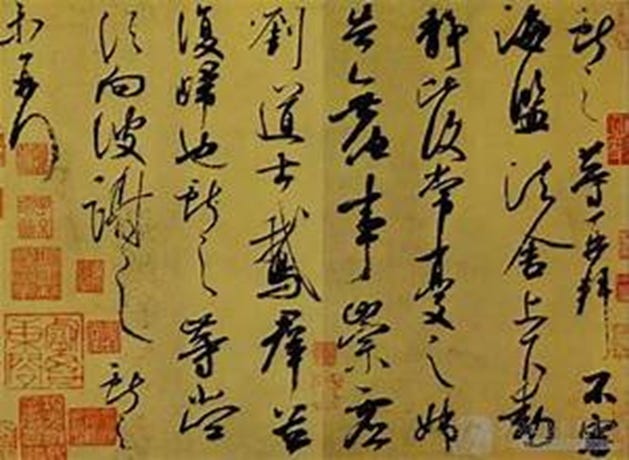
The “Flock of Geese Tie” (《群鹅帖》) is “said to be Mi Fu’s copy of a transmitted version of Wang Xianzhi,” written in a mixture of running and cursive scripts; the original ink manuscript is no longer traceable. The content is an ordinary letter, with phrases such as “海监,” “鹅群并复归,” and “向彼谢之.” The layout is plain; the strokes rise and fall with ease. The many seals, densely placed yet orderly, suggest a well-documented provenance. Precisely because it stands between “the Two Wangs” (二王) and the Song masters, this copy becomes an excellent laboratory for the study of line: what Mi Fu (米芾) took from Wang Xianzhi (王献之), and how he went beyond it.
When it comes to “line,” the two calligraphers share a lineage but diverge in aim. Wang Xianzhi of the Eastern Jin (东晋) inherited the discipline of Wang Xizhi (王羲之) while opening his own path. Critics often note his “fusion of running and cursive,” his “single-stroke writing,” and a style “graceful yet strong.” Put simply, he turns characters into a continuous breath, converts corners into rounded turns, courts fewer knife-edged cuts and more circling motion, and governs the whole with an unbroken flow. Mi Fu of the Northern Song (北宋), who “collected the ancients into his model books” and revered the Two Wangs, was not content with placid continuity. He worked with differences in speed and in the lift-and-press of the brush: reverse entries, side exits, turns in all directions; lines lean and tensile; ink alternates among rich, dry, moist, and thirsty; structures tilt; the line of travel runs in wave-like swells. In short: Wang Xianzhi emphasizes the continuous breath; Mi Fu adds perilous momentum. This “Flock of Geese” copy stands exactly between them: continuity unbroken, yet animated by Song-style speed and ink effects—an ideal specimen of inheritance, transformation, and re-creation.
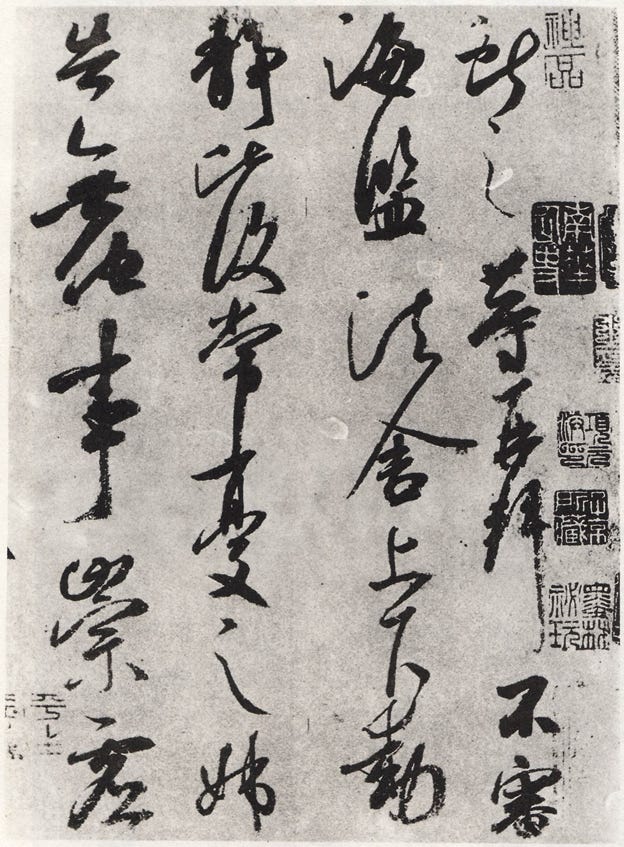
From the standpoint of character structure, Wang Xianzhi tends to tighten the center of the character, with measured opening in the four directions. He “turns within the bone,” refusing to take force from grand expansions. In this letter, characters such as “海监,” “上下,” “动静,” and “谢” show a compact core with relaxed edges: verticals are tall and slim; horizontals often flick lightly; left and right diagonals do not sprawl. This is the Jin method of an inward-pressing structure. Mi Fu keeps that inward press, but deliberately shifts the center of gravity to create risk: thickening on one side while tightening the other; lengthening the left stroke and shortening the right, or the reverse; light above and heavy below, or tight above and open below. In “监,” “静,” and “谢,” the final strokes often expand outward and then snap shut; the center of gravity does not sit obediently in a geometric middle but seems “about to tilt, yet holds.” This “precarious yet steady” balance is the Song advance on Jin principles. The lesson for learners is plain: begin with Wang Xianzhi’s “tight within, relaxed without,” then add Mi Fu’s shifted centers to court danger. Do not reverse the order. To seek risk before building the bone is to end in looseness.
Brushwork makes the divide even clearer. Wang Xianzhi often begins with a reverse entry and a concealed tip, then proceeds with a center-tip line. His lifts and presses are fine-grained, never theatrical; turning predominates, angular breaks recede; the line remains continuous without lag. Even when a letter demands speed, his line is like refined silk—breath unbroken, tendon unseen. Mi Fu’s entry often moves in the rhythm “cut in—slant out—return to center.” The reverse entry comes at a sharper angle; the range of lift and press is wider; the halts and surges are audibly clear. He likes to “brush” a long left-falling stroke or a lifting hook, and at the close flicks the wrist back to return the tip, the stroke-end like a flying sweep. In “不审” and “海监,” many strokes are linked, and not just linked: within the linkage the lifts and presses are layered—one stroke not fully ended before the next begins; one segment slightly dry, the next suddenly moist. This “stealing ahead” and “sudden shift” is exactly Mi’s intention. The training path falls into place: first pursue rounded continuity, then add reverse entries and lift-and-press; first keep to the center tip, then allow sideward force; first master linkage, then place breaks where breaks should be.
The difference in ink method is another clear thread. We rarely see Wang Xianzhi’s originals, but from Tang-Song copies and related rubbings we can infer his ink character: moist without greasiness, pale yet bony, like a fine rain across the sky, with few broad patches of dryness. Though the “Flock of Geese” we have is a copy, it still shows the moisture control required by continuity: no drastic jumps in tone across a line, rich places not oppressive, pale places not empty. Mi Fu turns the ink method into a “layered drama”: within a single line he arranges sequences of rich—pale—dry—moist, not to show off, but to respond to lift-and-press so that rhythm gains distinct voices. In characters like “群,” “归,” and “谢,” the main strokes often begin full, grow slightly dry midway, then return to moisture at the end: dryness within moisture, moisture after dryness, the page breathing in and out. Practice follows a simple order: first stabilize the page-wide moisture for “one continuous breath,” then add rhythmic layers. Try the “three bowls of water, one bowl of ink” gradient—one bowl clear, two light, three medium, and a separate bowl rich—then write a line in the order “clear—light—medium—rich—medium—light,” to feel the proportion between line and ink.
Layout determines how we read. Wang Xianzhi often spaces according to the pauses of meaning. Line spacing and character spacing are relatively even; weight within the line is solved by brushwork, not by layout theatrics. In the first column on the right, “海监诸舍上下动静,” the characters are close but not cramped, and the line spacing opens slightly from center to left, like coupled clauses taking a natural breath. Mi Fu’s layout is more like verse. Within a single line he will deliberately raise or enlarge certain characters so that the current rises and dips; at line ends he likes either to flick outward or to press and stop, so the line change feels like the return of a wave. Even as a copy, this piece shows that swell: in the lines with “静,” “归,” and “谢,” the brush either lifts or settles, making a clear undulation; the horizontal edges of neighboring lines are not forced into alignment, but let the varied lengths of characters produce a deliberate irregularity—Song aesthetics: not uniform yet coherent. When copying, one may plan in three steps—sense units, breath points, and linkage or break. Mark the divisions of meaning; assign in each phrase a “breath point,” where the line can relax; then decide whether to link within the character or to break between characters. Fix these three, and the layout arranges itself.
From here we can outline at least four inheritances Mi Fu takes from Wang Xianzhi. First, continuity as the guiding thread: characters become lines, lines become breath; however much he loves risk, he never writes in fragments. Second, rounded turning as the base: whatever the sideward force, the core remains the return of the center tip; sharpness is surface, the bone remains round. Third, a tightened center: beneath outward expansion lies an inner latch; without that inward “catch,” risk becomes mere agitation. Fourth, the mutual reference of running and cursive: he does not split the two; within a sentence running script steadies the pitch while cursive accelerates the passage, in direct lineage from Wang’s “hybrid” practice. At the same time, Mi Fu advances Jin practice in four ways: he enlarges lift-and-press so that “rounded continuity” becomes “roundness with audible beats,” turning speed into palpable rhythm; he shifts the center of gravity—through tilts, offsets, and mismatched lengths—to build danger and a modern sense of “precarious yet steady”; he layers ink tones within a single line so that visual rhythm runs alongside semantic rhythm; and he shapes a wave-form layout that governs the whole with rises and falls, so the reading moves from prose toward music.
For today’s learner, a workable path is “Wang Xianzhi—Mi Fu—then back to Wang Xianzhi.” Begin with the Jin toolkit: continuity, rounded turns, a tightened center. Proceed to the Song toolkit: lift-and-press, shifted centers, layered ink. Then return to Jin to test the purity of the line. To that end, one can also disassemble practice. In structure, use a nine-grid to locate the center and mark the weight, and repeat the sensation of “tight within, relaxed without.” In brushwork, practice three types of reverse entry—straight, slant, and curved—and four degrees of lift-and-press—light, even, heavy, and extreme. In ink, set a sequence within a single line—rich, medium, light, dry, moist—demanding continuity without fuss. In layout, first draw provisional columns and mark “breath points” on the paper, then write, avoiding the habit of “wherever the brush goes.”
Using the “Flock of Geese” as an example, one can proceed in three steps. First, “outline the bones”: with a hard pen or a dry brush, sketch the inner skeleton of each character—only the central core, the main stroke, and the closing movement. Second, “run the center tip”: switch to a moderate moisture and keep strictly to the center tip, writing in one continuous breath to pursue continuity and rounded turns. Third, “accelerate with lift-and-press”: without losing the line quality of step two, overlay differences in pressure and speed, and place a few “risky” shifted centers where appropriate. Common pitfalls are worth avoiding: imitating the pose while neglecting the line, looking like Mi in posture but falling like wood in the stroke; chasing risk while forgetting the bone, tilting enough but lacking the inner latch so that the line drifts; courting dryness while neglecting moisture, treating flying white as an end rather than a by-product; pursuing linkage while forgetting the break, keeping the breath unbroken but losing the music of phrasing—the letter’s “sense units” unheard.
Look again at the “Flock of Geese.” It is a letter, plain in tone and friendly in feeling; because it is plain, the brush-intention shows truer. Wang Xianzhi’s continuity and tightened centers lay the ground; Mi Fu’s lift-and-press and shifted centers bring the layers to the surface. The first column on the right opens carefully in speed; those to the left open further. From “动静” to “谢之,” the lines step like stairs, the beat unmistakable. Many seals, yet the momentum holds; they echo, rather than disrupt, the Song respect for Jin method. Set within a longer arc of history, the point becomes sharper: the Eastern Jin wins with “breath,” the Northern Song with “momentum.” This letter lets us see both the continuity of breath and the swell of momentum. A learner who can bring these two ends together will not fall into the trap of copying appearances while missing the line.
In the end, the Jin masters left an unbroken line; the Song masters added a body of rising and falling force. A letter like this—Mi Fu’s copy after Wang Xianzhi—spells out the relation between line and momentum. For today’s practice, two maxims suffice: first write the line into breath; then write the breath into waves. If the line is made, everything else can be added. If the line is not made, however lively the posture, it is only noise. Hold to that single line before speaking of a body of force, and the “Flock of Geese” will become what it is: a touchstone for testing the line of transmission
.