
Form Captured, Spirit Missing
— An Appraisal Report on a Calligraphy Scroll Signed “Wang Duo” (《对一件署名王铎行草的鉴定报告》)

Ren Jingjing (任晶晶)
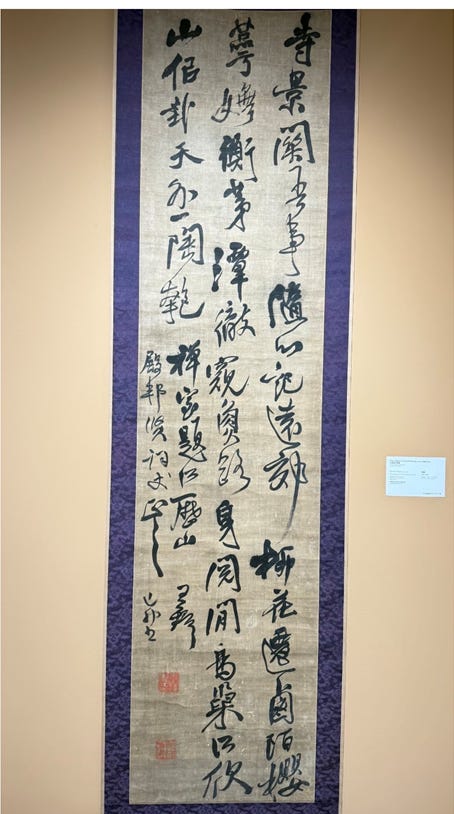
To hold forth on the basis of photos is always a risky business, yet experience suggests this: whether a piece of calligraphy “resembles” the master can often be grasped at a glance; whether it “is” the master requires peeling back, layer by layer, the brushwork, the formation of characters, the overall composition, the paper and ink, the seals, and the aura of mounting. The scroll at hand—signed as a work by Wang Duo (王铎)—from general impression down to minute detail, shows several key discrepancies from authenticated pieces by Wang, and so warrants careful scrutiny. What follows rests on direct judgments drawn from the images viewed in full; it is for scholarly discussion only and does not constitute a final verdict. A conclusive ruling would require examination of the physical object, supplemented by material analysis and bibliographic verification.
Begin with brushwork. In Wang Duo’s handling, “bone” outweighs “flesh”: he favors the centered tip, enters against the stroke and exits level; at turns one often sees the “nail-like break” and palpable pauses; the upward and downward presses are clear; within strokes the qi-flow is continuous; dry and wet alternate without clogging or blur—“sinew and bone contained within, richness issuing without.” In authentic pieces one often encounters dramatic apertures of energy: the long tip driving downward, momentum wrapping the tip, a pause with pullback, then a break with the side of the brush; the flying white is not the powdery flaking of dryness but the silky glint naturally split open by speed and moisture in tension. In this piece, most horizontals and left-falling strokes lack the reverse-tip priming at the start, often dropping flat-headed straight away; many turns slide past like a casual bend, without the resistant “pause.” Midsections of verticals turn hollow, the line’s core unsteady, the brush belly spilling outward into a glutinous line without sinew. Areas of flying white appear in sheets of dryness, as though skimming the surface with a dry brush to court “antiquity,” rather than the natural fissures opened by speed breaking through ink. Several long right-falling strokes in particular end without the “returning tip” that tucks the head: the tip frays, control is lost, the consummate “closing force” fails to appear, and the work’s mechanical structure loosens overall.
Now the formation of characters. The wonder of Wang Duo’s running-cursive lies in the balance between “inclination” and “inward torsion.” His structures tend to be elongated, the center of gravity set slightly to the upper right: tilted but not toppled. The same radicals within a line vary with profusion, yet all obey an underlying “ancestral skeleton.” In this piece, a number of forms tend toward the “squat and broad,” spreading laterally with insufficient vertical tension; there is tilt without the countervailing correction, and the result is “leaning” that does not “stand.” Recurrences of the same components are overly uniform—for instance, the water, hand, and heart radicals repeat with high sameness—suggesting a character-by-character copying of a pattern, rather than improvisation born of the composition’s rhythm. Within single characters, the “inward twist”—that is, drawing the force toward the center at turns—rarely appears; most turns are simply allowed to pass with the flow. In some characters the proportions among components are off (top too large, lower section shrunk), yielding a stacked feel where interpenetration—true “weaving”—should be.
Now the overall composition. Wang Duo’s deepest mastery appears in the “breath” formed by character spacing, line spacing, and ink modulation as an organic whole. He excels at interspersing abrupt large characters with hidden small ones, so that the sheet rises and dips like a landscape of ridges and hills, danger balanced by repose. Line trajectories often “seek the straight within the slant”; though the columns lean, the overall vector moves forward and then gathers, expanding and contracting with measure. From top to bottom, this piece also plays with size contrasts, but the rhythm feels mechanical: within one or two lines a repeated beat of “uniformly large—uniformly small” emerges, as if the hand were consciously “performing” a visual formula of Wang. Between lines, the “yielding” and “interlocking” are inadequate; line-ends often land with a sudden large character as a period, but what follows lacks the corresponding “turn back” and “resolution,” producing punctuation rather than melody. In the lower section, the ink force wanes; the writer seems to enlarge character size to compensate. This is uncommon in Wang’s authenticated works—when he finishes with large characters, one still feels the “back-hook” of inner strength, not a simple substitution of “bigger equals stronger.”
Ink and paper also offer clues. In the photos, ink layers often appear dry and matte; edges of dry-brushed zones are rough, more “split” than “soaked”; in dense areas, the ink body floats, sitting on the surface rather than entering the paper. The classic “five colors within one ink”—gradations from dense to light, from moist to dry within a single stroke—are underdeveloped here. The ground tone of the paper is a uniform gray-yellow; in many places the fiber pattern shows “parallel ripples,” not entirely consistent with the natural mottling of well-aged papers. Signs of aging read like an “overall cosmetic.” The mounting uses a purple patterned brocade; the contrast between border and field suggests a relatively recent remounting. These observations are all subject to distortions of white balance and ambient light in photography, of course; but compared with the “old fragrance” one senses in Wang’s numerous authenticated works and old mountings, the sense of period here does not prevail.
The seals are especially sensitive. At the lower section there are two red square intaglios, one vertical above, one horizontal below. In the enlargements, border lines look straight and hard, corners unevenly rounded and blunt. The seal script is neatly formatted, the knife-work even, lacking the hand-hewn irregularities—unequal starts and stops—often seen in old seals. The cinnabar red skews bright, with little granularity, the “vivid and shallow” tone common in modern paste; old paste that has penetrated the paper often shows a deep maroon or jujube red, with a capillary fringe at the edges, which here is weak. Whether the legends match seals Wang frequently used is critical. Wang’s common seals include “Seal of Wang Duo” (「王铎之印」), “Seal of Wang Juesi” (「王觉斯印」), “Juesi” (「觉斯」), and “Crazy-Transcended Daoist” (「痴絶道人」), whose scripts range from archaic-seal to small-seal, with lively distribution of negative space; borders often show “flying slants” and chipped corners from age. The vertical legend seen in the third image is strikingly grid-regular, with an exaggerated block of blank space on the left—more like a modern pastiche with a “designed” layout. If no such seal can be located in the repertories, suspicion increases; even if a match is found, the cut must be compared: on genuine seals the rhythm of “knife entering—running—exiting” is audible, and line-weight breathes; later recuts tend toward uniform neatness. Placement also matters: in running-cursive works Wang often uses two seals at the lower section—one to “weight the corner,” another to “formally close”—and he is attentive to “avoiding the stroke and conforming to the force,” so the seals echo the text’s momentum. Here, the distance and relation between seals and script feel somewhat stiff, like a scenic addition made after the fact.
Finally, the “qi-aspect,” the total style. Wang’s qi derives from a synthesis: the Two Wangs as canon, the bone of Yan and Liu, the knotty force of the Northern steles. First, “one breath threading the sheet”; second, “slanted yet self-standing”; third, “in the sweep, inner force is gathered.” In this piece the “aperture of breath” opens decently in the first line but weakens mid-course; the ending attempts to pound out a cadence with enlarged forms, yet the expected “back-hook” of energy does not return, and the close has no lingering overtone. In other words, it resembles a completed pastiche of “Wang-like intention,” rather than an “improvised emergence” driven by a powerful inner meter. Pastiche runs into two familiar difficulties: first, the qi-channel that runs “from hand into heart”; second, the rhythm that becomes “involuntary.” The first determines whether a line has a core; the second whether a composition can birth the “unprefigured beauty.” This piece is lacking in both.
Of course, fakes come in degrees: from museum-copy refinements to hasty shop-floor formulas. The “formulaic Wang” on display here—inclination, size contrast, dry–wet opposition, oversized characters to close, two seals to bind the corner—shows that the maker knows Wang’s “outer grammar,” yet falls short in the “inner grammar” of mechanics, breath, and rhythm. If one sets it beside such transmitted masterworks as Imitating the Ji Jiu Zhang (《临急就章》), Imitating the Collected Posts of Wang (《临集王帖》), and Poem on a Painting (《题画诗卷》), the difference grows clearer: in genuine pieces, lines run like meridians; dryness is never desiccation, moisture never mere float; within inclination there is righting; amid danger one finds steadiness. Here, lines are often swiped through, as if “finishing” rather than “arriving.”
On the strength of the foregoing observations, I incline to the view that this is unlikely to be by Wang Duo’s own hand and is more probably a later imitation. It “resembles” without “being,” chiefly in these respects: lines lack the core strength of “sinew within bone”; many structures spread flat and broad; the compositional rhythm is mechanical; ink layers are thin in modulation; the paper and mounting exude a relatively modern air; the seal script and cutting suggest recent work. Naturally, photographs are limited: color balance and compression affect perception. I therefore phrase my conclusion as “strongly suspect,” not “categorical.”
Does this justify a peremptory ruling of forgery? Prudence suggests three corroborations. First, bibliographic verification: consult The Complete Calligraphy of Wang Duo (《王铎书法全集》), Chinese Calligraphers’ Seals (《中国书法家印典》), Collected Treasures of Ming–Qing Calligraphy (《明清法书集珍》), and others to check the styles, borders, and placements of these two seals. If no such seals are recorded and their design feels modern, the doubt deepens; if they are recorded, the knife-work must still be compared. Second, material testing: paper fibers (handmade bark paper or machine-made “archaized” stock), the ratio of alum to glue, the morphology of carbon particles in the ink, the sulfur–mercury composition and crystal structure of the seal paste—all can yield dating evidence. Third, the chain of provenance: origin, old mounting labels, colophons, collector’s seals—can they establish traceability in the modern era? If all three fail to support the piece, and the stylistic evidence diverges in multiple respects, the probability of “not genuine” is high. With access to the object and repertory side-by-side, the truth could be approached more closely.
As for “pleasing to the eye” versus “authentic,” they are not the same question. Even if a pastiche, the piece offers students several “surface routines” worth studying: the inclined layout, the interleaving of sizes, the dry–wet counterpoint, the paragraphic expand-and-contract. But if one takes this as “Wang’s method,” one learns only “what looks like Wang,” not “what makes Wang Wang.” The true Wang Duo relies on consummate control of brush nature and a breath that runs through the whole; he tempers the gentle warmth of the Two Wangs into something steep and erect, fuses the knotty force of stele studies into running-cursive, perilous yet unruffled. The fourfold corroboration of “qi,” “bone,” “method,” and “measure” is the watershed in authentication. On present evidence, I recommend great caution from a collector’s standpoint: without solid provenance and testing, refrain from a hasty decision. If used for study and viewing, it may be treated as a fairly standard “Wang-style model pastiche,” without assigning it a place among authentic works.