
Finding Balance Between Antiquity and Modern Sensibility
— A Review of Lai Xueyou’s New Semi-Cursive Work (2)

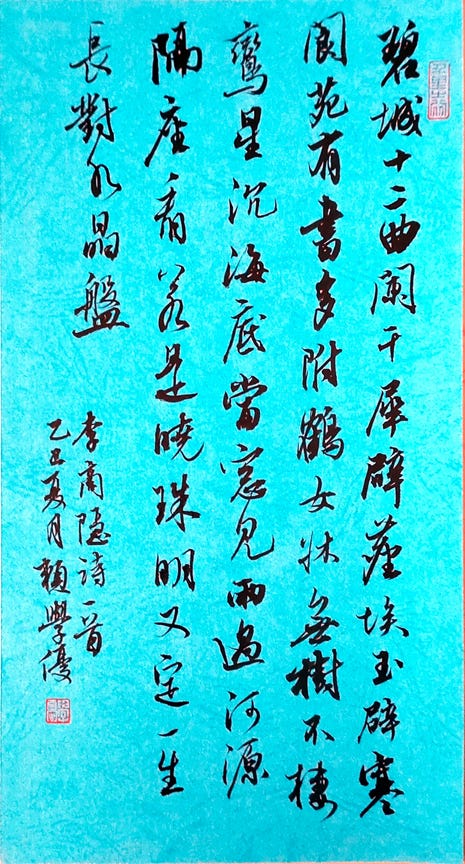
Lai Xueyou’s latest semi-cursive scroll unfolds like a conversation between antiquity and contemporary sensibility—each column of ink on the vivid turquoise ground bearing the weight of centuries-old practice while also gesturing toward unexpected breaths of individual freedom. From the outset, one senses the work’s conscious dialogue with Tang and Song running-script traditions: vertical strokes bear the imprint of Yan Zhenqing’s grave strength, hooks and turns echo Wang Xizhi’s refined dynamism, and lighter, feathered edges recall the spirited spontaneity of Mi Fu. Yet this is no mere pastiche. Instead, Lai calibrates these familiar models into a voice that is peculiarly his own, forging a balance between restraint and expressive release that animates each character in turn.
His brushwork exemplifies a command of weight and modulation that only decades of disciplined practice can yield. The interplay of press-and-lift—thick, solemn strokes giving way to thinner, more translucent passages—carries an almost musical rhythm, reminiscent of breathing itself. At moments when the brush is fully loaded, the ink sinks into the fibrous paper with palpable gravity; elsewhere, as the tip dances lightly, it leaves a web of dry-brush texture, suggesting movement rather than stillness. Such contrasts are never gratuitous. They serve to establish a cadence across each line, guiding the viewer’s eye through rises and falls that feel both inevitable and surprising.
Character structure is another arena in which Lai’s lineage and innovation converge. In well-balanced forms with a clear central axis, radicals distribute themselves with harmonious proportion, neither too tight nor too dispersed. In more complex characters—those bearing five or six strokes of varying orientation—the composition avoids clutter by subordinating secondary strokes to the primary spine, allowing the eye to register the principal gesture before exploring subsidiary details. Only in a few isolated instances does one detect a slight over-compression—where two densely interwoven elements brush too close, briefly disrupting the work’s otherwise generous sense of space. These moments, however, are rare and serve more as reminders of the challenge inherent in sustaining structural spaciousness across a long scroll than as indictments of technical failure.
Perhaps most striking is Lai’s handling of overall layout, or zhangfa, which reveals an intuitive sense of pacing seldom encountered outside the most accomplished masters. The spacing between columns neither rigidly uniform nor recklessly varied, but calibrated to produce alternations of tension and repose. Some columns crowd the eye, their characters spilling en masse, while others breathe more deeply, their emptier intervals inviting reflection. This ebb and flow creates a visual tempo that feels akin to musical phrasing, as if one were listening to a slow adagietto punctuated by sudden accelerandi. According to exhibition records from the Seventh Guangdong “Nanya Award” Calligraphy and Seal Carving Exhibition, Lai’s work has repeatedly drawn the jurors’ attention for precisely this mastery of spatial music—an acknowledgment that places him among the province’s most respected practitioners.
Critics writing about his earlier pieces have likewise noted this gift for compositional drama. At the Sixth Guangdong Province “Dali Cup” Calligraphy and Seal Carving Exhibition, commentary highlighted how Lai negotiates the boundary between controlled structure and gestural abandon—a duality that gives his lines both solidity and surprise. Across his body of work, one sees a steadily evolving approach to line density: earlier scrolls leaned more heavily on even regularity, while recent works deepen contrast and introduce more pronounced moments of visual counterpoint. In the present piece, those evolutions culminate in a sophistication that feels both assured and still willing to explore new tensions.
Underlying all these technical achievements is a stylistic temperament that privileges clarity over flamboyance—a commitment to disciplined elegance that resonates with principles articulated in recent discussions of calligraphy criticism. As Li Xinling observes, “the task of calligraphy critique is not to drown the reader in ornamental language, but to guide understanding of the work’s fundamental integrity” . Lai’s own restraint—his reluctance to resort to flashy exaggerations—aligns with this ethos. Even when the brush arcs in a sweeping flourish, the gesture never tips into ostentation; instead, it remains tethered to the scroll’s larger structural logic, as though every expressive impulse is counterbalanced by an inner monitor of compositional coherence.
Yet this very discipline can be double-edged. In a few passages, the cumulative regularity of stroke weight and spacing produces a sense of safe predictability. One wonders what might emerge were Lai to introduce more dramatic ruptures—perhaps a single column of deliberately oversized characters, or a sudden shift into extreme dry-brush austerity. Given his track record of absorbing classical models, it is likely he could integrate such departures without fracturing the overall harmony. Indeed, his willingness to evolve is evident in online discussions among calligraphy enthusiasts, where forum posts have praised his readiness to experiment with brush angle and paper grain. Allowing these experiments to take bolder forms may be the next frontier in his artistic growth.
Another dimension ripe for refinement lies in the transitions of ink tone. At present, heavy black sometimes gives way to light gray with a discernible jolt—an effect that captures attention, but not always for the right reasons. A more gradual fade, achieved through subtler adjustments of ink dilution and brush pressure, could heighten the scroll’s atmospheric quality. In sections where the darkest strokes dissipate too abruptly, the eye is jarred rather than gently led. By extending the middle ground of medium-tone gray, Lai could weave a more seamless continuum from the work’s densest points to its most ethereal moments.
The signature seal and colophon, placed at the margin with careful deliberation, contribute a final, punctuation-like flourish. The cinnabar red of the seal offers a vibrant counterpoint to the black-and-turquoise palette, anchoring the scroll’s visual weight without encroaching on the written text. Its placement, neither too central nor too marginal, suggests that Lai regards the seal as an integral musical motif rather than an afterthought. This approach to seal carving and placement has been cited in provincial award bulletins as exemplary in balancing identity and unity—another accolade that underscores the breadth of his technical and aesthetic achievements.
Stepping back, one sees in Lai Xueyou’s work not just the sum of brush-stroke mastery or compositional savvy, but the imprint of a mind deeply attuned to calligraphy’s dual nature as both craft and meditative practice. Each stroke records a moment of physical engagement—of wrist, elbow, and shoulder moving in concert—while also capturing a fleeting state of mind. This unity of body and spirit is what gives the best calligraphy its ineffable quality, and Lai’s scroll carries that quality in ample measure.
To push further along this path, he might consider embracing controlled unpredictability. Moments of intentional imbalance—an unexpected tilt here, an abrupt pause there—can awaken the viewer’s attention in unprecedented ways. Experimenting with paper textures or ground colors beyond the current turquoise might also open new dialogues between ink and substrate, challenging assumptions about background neutrality. Finally, further refining the gradations of ink tonality will create an even richer matrix of light and shadow, deepening the scroll’s capacity to convey mood as well as form.
In sum, Lai Xueyou stands at a vantage point where tradition and innovation converge. His latest semi-cursive scroll confirms his status as a mature calligraphic artist—one whose technical prowess and aesthetic discernment have been recognized by prestigious provincial exhibitions and online commentary alike. At the same time, the work hints at future possibilities: the exhilarating tensions that await between the known envelopes of classical form and the uncharted territories of personal expressiveness. Should Lai choose to navigate those tensions with the same calm assurance that has brought him this far, his calligraphy may well chart new courses for the art form itself—proving once again that to breathe between antiquity and modern aesthetics is to inhabit the living heart of calligraphy.
Calligraphy Appreciation | Art Commentary | Book Reviews | Chinese-English Translation & Bilingual Publishing
For inquiries, please contact:
World Chinese Publishing
Chinese Literature and the Arts (艺文中国 in Chinese and English, distributed worldwide) Chinese Calligraphy Review (Douban Books)
Website: worldchinesepublishing.com
Email: minellc@gmail.com