
Exploring Between Wild Abandon and Formal Discipline:A Critical Review of Yu Xuan’s Graduation Piece
《在奔放与法度之间探索 ——雨萱毕业作品评析》

By Ren Jingjing
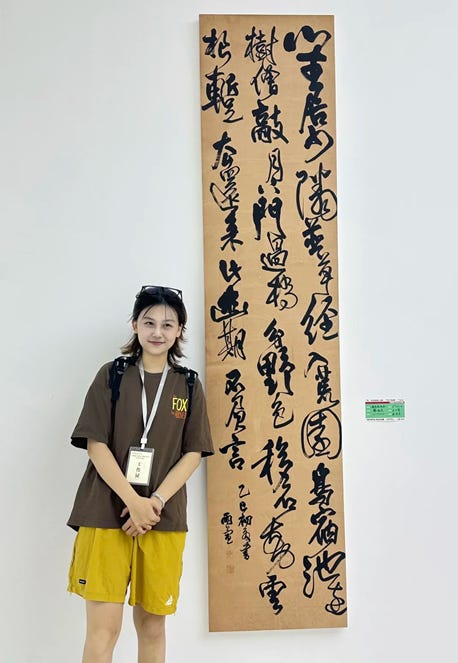
Yu Xuan’s graduation piece, a bold vertical hanging scroll executed in rich black ink on warm-toned xuan paper, testifies to her emerging presence within the continuum of Chinese cursive calligraphy. Standing before the scroll, one immediately senses the interplay of tradition and youthful audacity: the confident sweep of her brushstrokes, the off-kilter yet purposeful alignment of characters, and the robust tonal contrasts that suggest both reverence for her predecessors and a personal impulse to innovate. Over the past year, online commentators on various art forums have remarked on similar tendencies in Yu Xuan’s other works: they admire her fearless use of saturated ink, her willingness to stretch characters beyond comfortable confines, and the visceral energy she pours into each stroke. At the same time, these critics note a certain unevenness in execution and occasional lapses in spatial harmony, marking Yu as an artist in the throes of self-discovery. To understand the significance of this piece as a university graduation exhibition, it is instructive to compare it with two canonical models of cursive script from the late Ming dynasty—Wang Duo and Xu Wenchang—whose works illuminate both the aspirations Yu chases and the benchmarks she has yet to meet.
In the realm of cursive calligraphy, Wang Duo (1592–1652) occupies a singular position, celebrated for his fusion of the muscular vitality of Zhang Xu and the structural rigor of Yan Zhenqing. Wang’s cursive is characterized by explosive spontaneity tempered by an underlying framework of balance. His long, arcing strokes often begin with a sudden weight of ink, then taper into a featherlight lift, all while maintaining coherent internal proportions. Observers of Wang’s compositions are struck by how a seemingly wayward line never veers into chaos; his pen remains tethered to a masterful sense of rhythm and a reservoir of classical forms. In one of his most famed scrolls, written in tribute to his friend Gao Ethan, Wang’s cursive characters cluster and then spread across the paper like a flock of birds, each word oscillating between density and weightless flight. His mastery of tempo and contrast provides the blueprint for any cursive calligrapher seeking to marry freedom with discipline.
Xu Wenchang (1599–1678), though less universally known than Wang Duo, offers another invaluable point of comparison. Xu, a contemporary of Wang, was equally drawn to the wild cursive tradition of Huai Su and the fluid elegance of Wang Xizhi. Xu’s cǎoshū revels in winding, hairline threads and sudden jolts of heavy ink, a symphony of yin and yang that reflects his background as a painter of landscapes and literati poetry. In Xu’s script, one encounters spacious halos of ink suddenly collapsing into a single, knife-like slash, or a loose coil of strokes that tightens into an unexpected knot. While Xu’s work sometimes borders on the cryptic—challenging the viewer to discern each character’s identity—its power lies in the intimate, painterly sensibility he brings to the brush. His calligraphy evokes mist-wreathed mountains or wind-whipped bamboo; it is a visual poem rather than a mere transcription of words.
Yu Xuan’s scroll, when juxtaposed with these two models, reveals both commendable achievements and clear avenues for growth. Her brushwork commands immediate attention: the ink is glossy and deeply saturated, and her strokes are delivered with ample wrist motion and decisive elbow turns. In several characters—especially those with long, sweeping horizontals—she achieves a sense of forward thrust reminiscent of Wang Duo’s dynamic arcs. These energetically charged passages demonstrate that Yu possesses the necessary physical courage to wield a large brush effectively, without reluctance to place thick ink onto receptive paper. Equally, there are moments of delicate grace, where she lifts the brush to produce a thinning ribbon of tone that breathes against the heavier forms. Such moments show a budding awareness of contrast and the potential for lyrical repose.
Yet the very vitality of Yu’s strokes sometimes works against her. In places where Wang Duo would have decelerated, letting the line find its balance, Yu rushes on, her heavy beginnings sometimes failing to taper with the same elegant restYut. The result is a handful of strokes that feel top-heavy, lacking the internal springiness one admires in Wang’s best work. Online reviewers have pointed out that in her other smaller format pieces, Yu’s strokes navigate this tension more successfully; the challenge when moving to a large-scale scroll appears to be sustaining her brush control over the entire expanse. There are sections where the ink pools too deeply, erasing the gestural nuance that lighter passages once promised.
The structural design of individual characters—what the Chinese tradition calls jiétǐ—also betrays Yu’s ongoing development. She clearly aspires to the “leaning” configurations favored by Xu Wenchang, in which the axis of each character surges forward, suggesting motion through space. In some columns of her scroll, characters indeed lean gracefully, as if caught mid-sway by a gust of wind. Yet in other rows, the same aspiring lean collapses into a cramped or overly slack form. For instance, an early character that echoes Xu’s supple twists appears harmonious, but a later repetition of the same form bulges at one corner, throwing off the visual cadence. Yu has absorbed the idea of “liú dòng” (flowing movement) but has not yet fully internalized the geometric precision that undergirds Xu’s deceptively loose script.
Perhaps most telling is Yu’s approach to overall compositional layout, or zhāngfǎ. She generates a sense of cascading descent—lines are not strictly vertical but trail diagonally, giving the piece a propulsive momentum. This strategy aligns with the structural bravura of Wang Duo, whose large scrolls often employ shifting pivots of density to keep the viewer’s eye in restless motion. Yu Xuan chooses her line breaks judiciously: she avoids mechanical regularity by letting characters of varying widths occupy each column, so as to break the monotony of perfect alignment. Furthermore, her modulation of ink tone—alternating spots of almost bone-dry brush with saturations of glossy black—shows that she knows how to stave off boredom. It is a promising sign that Yu Xuan attends to the duel between form and emptiness, between solid marks and blank space.
Nonetheless, whereas Wang and Xu canton their spaces with rigorous attention to the interplay of full and void, Yu Xuan’s shifts remain somewhat predictable. The density of marks across her scroll is relatively uniform, so that the eye perceives one broad swath of blackness rather than a variegated landscape of ink and paper. In the most accomplished portions of Wang’s or Xu’s works, one might linger over a single character’s airy halo of white, then plunge into a tightly packed cluster of robust lines—an experience Yu Xuan does not yet consistently deliver. Viewers have suggested that she experiment more boldly with “jiāng jū lìyù” (constriction leading to emptiness) whereby a sudden contraction of strokes leaves a pronounced island of negative space, heightening the drama of surrounding brushwork. Such spatial surprises are what elevate cursive calligraphy from mere penmanship to a living, breathing art.
Yu Xuan’s stylistic inheritance is unavoidably eclectic: she has drank deeply of the mid-Tang wild cursive lineage, ingested the nineteenth-century revival of cursive led by Lin Sanzhi, and absorbed modern abstractions à la Wang Dongling. Her current piece reflects this lineage in its controlled abandon, yet it lacks the ease of metamorphosis found in Wang Duo’s or Xu Wenchang’s masterpieces. Where Wang Duo feels as though every stroke is an evolution of impulse and every cluster of characters is an orchestrated gesture, Yu Xuan’s work sometimes reads as a sequence of individualized bravura moments loosely stitched together. To move beyond this, Yu Xuan must refine her sense of macro-structure, developing a more coherent visual grammar that binds one section to the next.
Among the strengths of this graduation piece are its palpable sincerity and the raw vitality of Yu Xuan’s personal expression. Too often in technical demonstration pieces, one encounters skilled but soulless execution: perfect strokes that seem to have been painted without a heartbeat. Yu Xuan’s work, by contrast, pulses with energetic immediacy. One feels the quickened breath behind each flourish. For a graduation exhibition—where the viewer hopes to perceive not just a display of learned technique, but the emergence of an individual voice—this is exactly the quality to treasure most. Yu Xuan’s strokes bear the trace of her unique hand, and those traces announce the arrival of an artist who will look back at this scroll as the first public statement of her long conversation with tradition.
Yet to advance toward a fuller maturity, Yu Xuan would do well to study deeply key works of Wang Duo and Xu Wenchang, not merely in terms of surface appearance, but in regard to the philosophical underpinnings of their art. Wang Duo’s cursive, though audacious, is rooted in an understanding of calligraphic frameworks laid down by Yan Zhenqing and Mi Fu: structure here is not casualty but consensual partner to vitality. Studying the codified stroke order of those models, and then deliberately unbalancing them, might give Yu Xuan a more nuanced sense of how to wield freedom without severing ties to form. Comparative exercises—copying a single phrase from Wang Duo’s “Du Fu Scroll,” then reworking it in her own hand—could reveal to Yu Xuan how the master tethers his rhythmic license to anatomical precision.
Similarly, Yu Xuan might immerse herself in the more painterly aesthetics of Xu Wenchang. Examining how Xu’s brush breathes texture into each stroke—sometimes through a near-dry brush, sometimes through a soaking release—would inform Yu Xuan’s own modulation of ink saturation. Such studies could inspire her to vary not only black versus white, but also the internal tonality within each stroke, from a glimmering silvery thread to the densest velvet black. These tone shifts, when mastered, enliven the broader composition and reveal a deeper rapport between brush and paper.
In addition to historical models, Yu Xuan could refine her sense of virtual space by exploring non-calligraphic forms of Chinese painting, particularly those that emphasize atmospheric layering—Ming literati landscapes, Song dynastic monochrome brushwork, or even coastal ink wash from Japan’s Zen painters. While these genres lie outside the narrow definition of cursive script, they share with Yu Xuan’s work the fundamental concern of tension between form and void. By experiencing how a painter negotiates the same white expanse that a calligrapher confronts, Yu Xuan will expand her spatial imagination and learn how to orchestrate her scroll’s blank paper with the same inventiveness she brings to thick strokes.
Finally, Yu Xuan’s path forward must involve rigorous self-critique. Engaging with a community of fellow artists—joining critique circles, responding to professional feedback, posting her works for commentary on WeChat art salons—will challenge her to articulate her formal goals and to test them against diverse viewpoints. Each critique session can become a laboratory in which she experiments with weight, speed, and compositional rhythm, discovering the precise alchemy that animates her personal style without resorting to mere mimicry.
Rain Xuan’s graduation scroll stands as both milestone and prelude. It announces the arrival of a young calligrapher whose energy, ambition, and reverence for tradition position her to make significant contributions to contemporary cursive calligraphy. In its brushwork, one reads her willingness to confront ink’s materiality; in its structure, her fascination with dynamic forms; in its layout, her yearning to chart a visual journey across paper; and in its style, her tentative but promising synthesis of historical lineages. Yet the same scroll reveals the ambitious terrain that lies ahead: the challenge of harmonizing impulse with restraint, ensuring that each stroke participates in a larger conversation rather than functioning as an isolated note. As Rain embarks on her post-graduation practice, the words of Xu Wenchang may well resonate: “Calligraphy, like painting, is a mirror reflecting one’s spirit.” May Rain Xuan’s mirror become ever clearer, revealing the mature artist latent within this vibrant graduation debut.