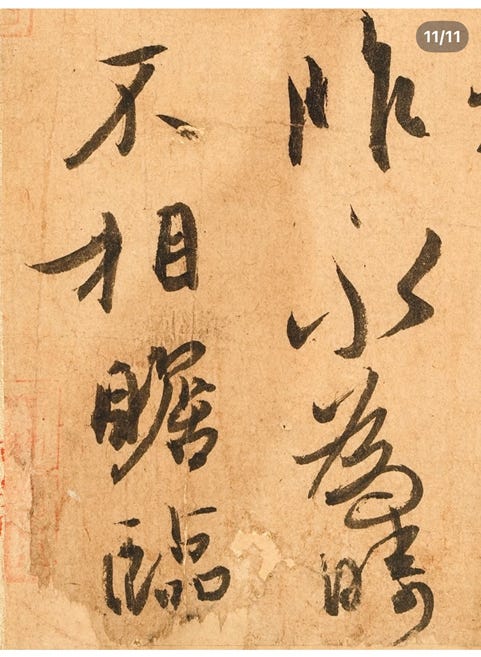
A Millennia-Spanning Attribution
— Reading the Boyuan Tie (《伯远帖》) through Speed, Pauses, and Split Tip

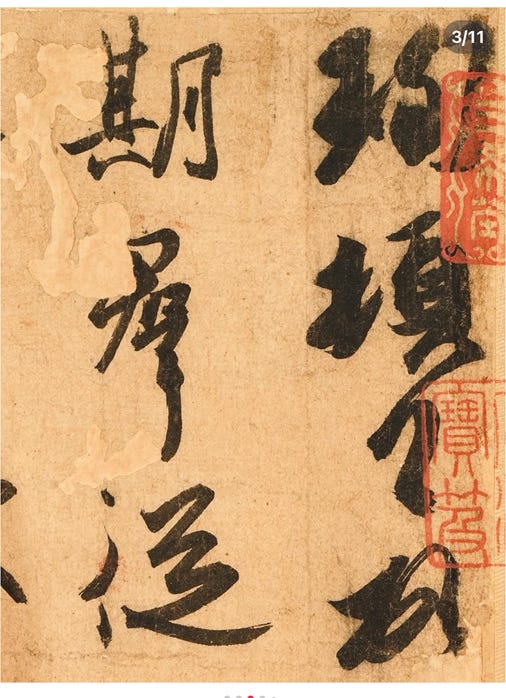
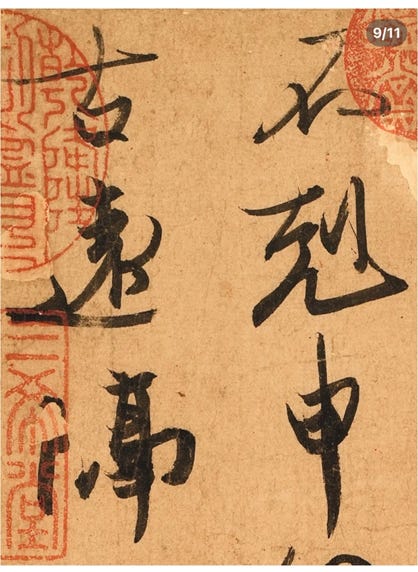
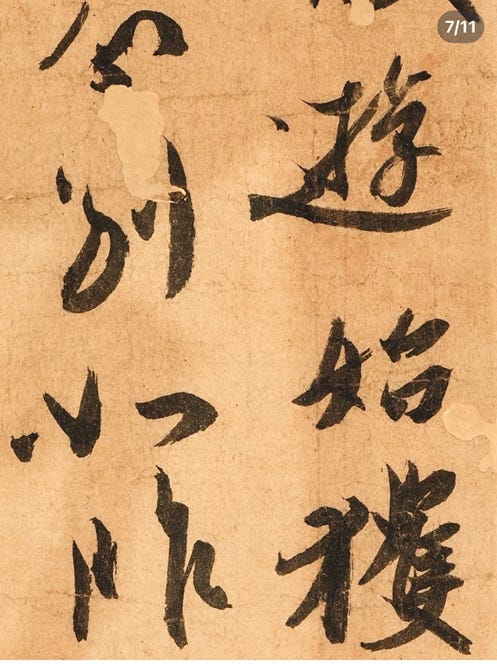
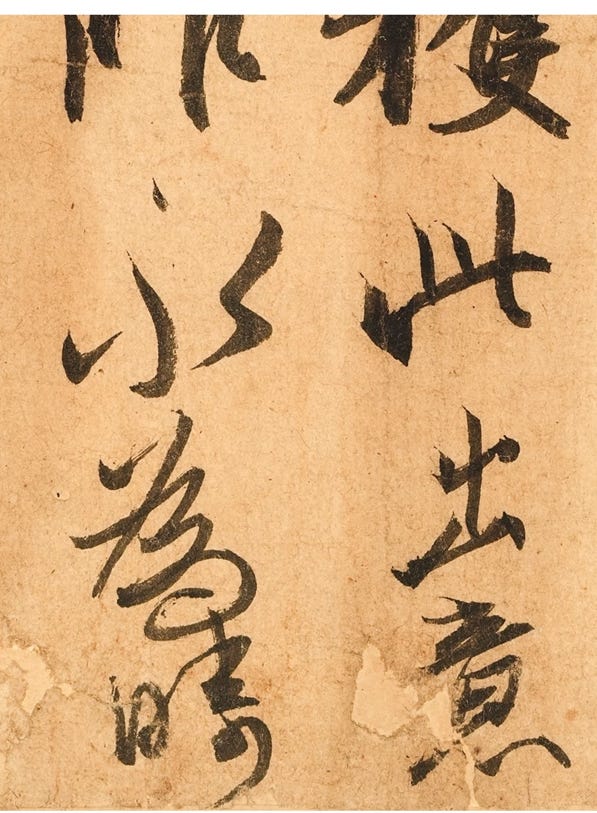
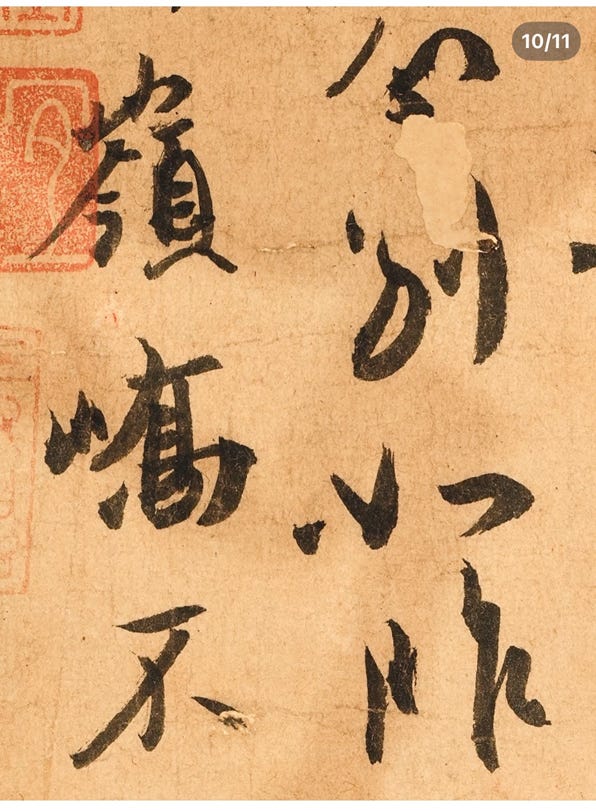
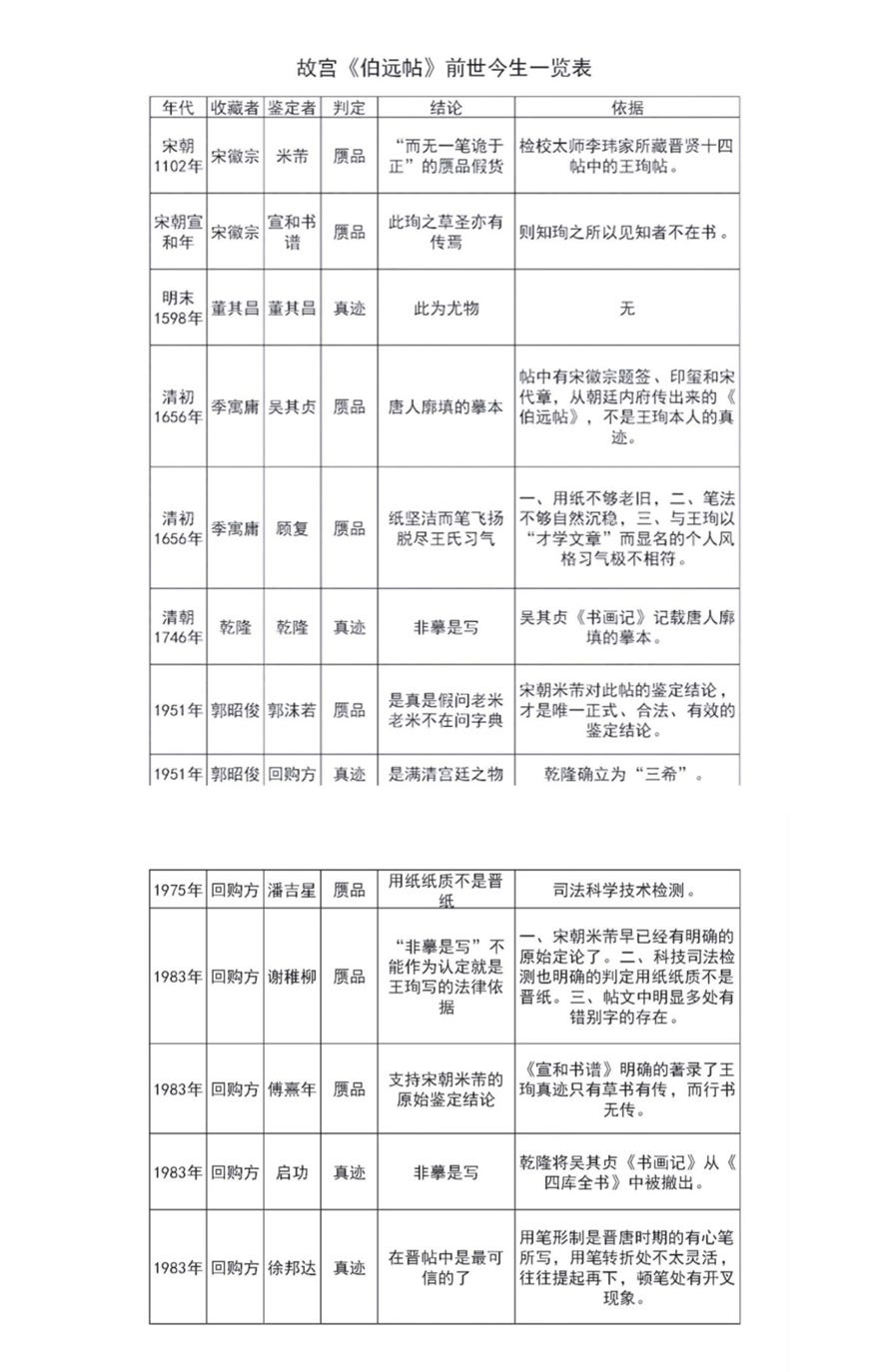
The screenshots accompanying this piece put the key points of contention around the Boyuan Tie (《伯远帖》) squarely on the table: the chain of transmission and documentation (from the Xuanhe Imperial Collection [宣和内府] to the Hall of Three Rarities [三希堂]), the disagreements among connoisseurs ancient and modern (from Mi Fu [米芾] and Dong Qichang [董其昌] to, in more recent times, Xie Zhiliu [谢稚柳], Fu Xinian [傅熹年], Qi Gong [启功], and Xu Bangda [徐邦达]), and those details in contemporary debate that are often “over-signified”—whether the writing speed is uniform, whether there are “pauses” at directional turns, and whether split-tip traces can serve as evidence of an autograph. I will try to bring together four lines—material evidence, historical evidence, aesthetic evidence, and technical evidence—to offer the most comprehensive, verifiable, and practice-oriented judgment and recommendations I can.
The Boyuan Tie ranks among the “Three Rarities” (三希). From the perspective of the Qianlong Emperor’s (清高宗) cultural politics, it was the highest badge of an orthodoxy grounded in the canons of the Jin masters; from the perspective of calligraphic history, it is also an object that generations of connoisseurs have repeatedly re-evaluated. Surveying extant materials, my leaning is this: the probability that it is an autograph by Wang Xun of the Eastern Jin (王珣) is very low; the probability that it is an exquisitely executed copy/writing from the early Tang–Northern Song (唐—北宋) is very high. Its significance in artistic value and canonical paradigm is not diminished in the least by its being “non-autograph.” I lay out the reasons step by step below.
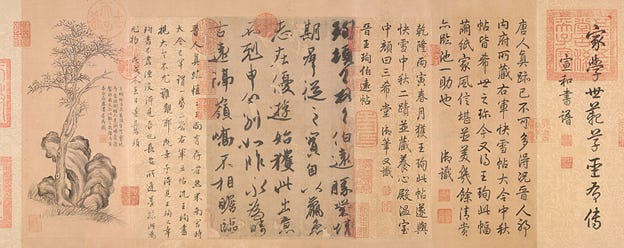
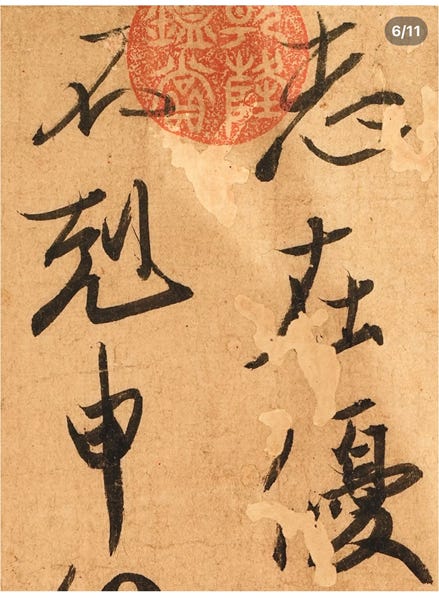
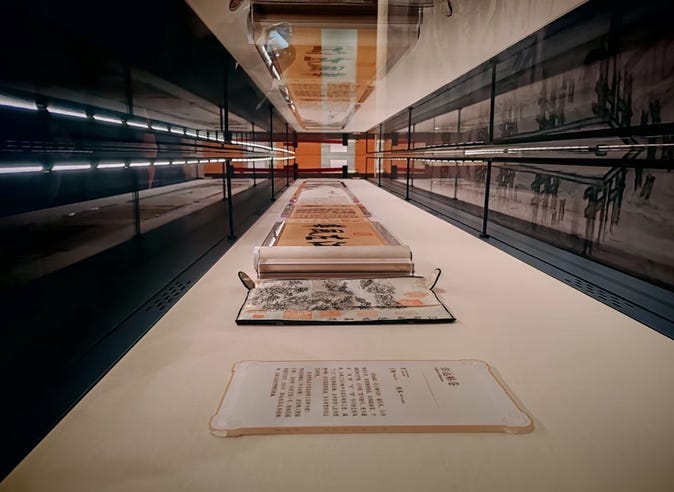
First, the material evidence. Authentic Jin-period ink traces exhibit a mutually corroborating constellation across paper fiber, ink stratification, mounting, and age-wear. In its present state (judging from public display), the Boyuan Tie’s paper fibers, ink layering, and mounting marks register a history of repeated remounting and repairs—no surprise, given the frequent re-mounts in the Hall of Three Rarities and the court’s habit of backing works; but this directly rules out any path that would determine a Jin autograph by paper and ink alone. It bears noting that multiple scholarly discussions and technical examinations indicate that the sheet cannot be pushed back to the Jin and more plausibly accords with Tang-Song craftsmanship. This does not “automatically” entail a forgery; it does suffice to exclude any strong claim of “original Jin paper plus original Jin ink.” As for seals and colophons, the traces of transmission through the Song, Yuan, Ming, and Qing are broadly intact, but “documentation ≠ proof of autograph.” At most it proves that “at a fairly early date this was already regarded as a top-tier exemplar of calligraphy by Wang Xun,” not that it is “certainly Wang Xun’s own hand.”
Second, the historical evidence. Song literati prized fatie and valued tracing; the imperial calligraphy atelier’s attitude toward “famous Jin and Tang masterpieces” was often to treat the most refined copies as the “standard text.” Mi Fu did not get everything right, but he saw clearly the cultural ecology in which “the Song took law from the ancients and esteemed copying”: many “masterpieces,” in his account, were objects “taking copy as standard.” Dong Qichang further elevated “the Song’s mastery of copying” into a full narrative of the transition from Southern and Northern Schools to Song and Yuan. By the Qianlong reign, the configuration of the “Three Rarities” bore an unambiguous imprimatur of cultural orthodoxy and imperial taste, which magnified a work’s symbolic status but cannot, in reverse, prove that it “must be a Jin autograph.” The reason the several modern “panel reviews” split into opposing camps is precisely that between “Wang Xun’s autograph” and a “high-antique copy/writing,” the historical record does not furnish a conclusive final hammer blow.
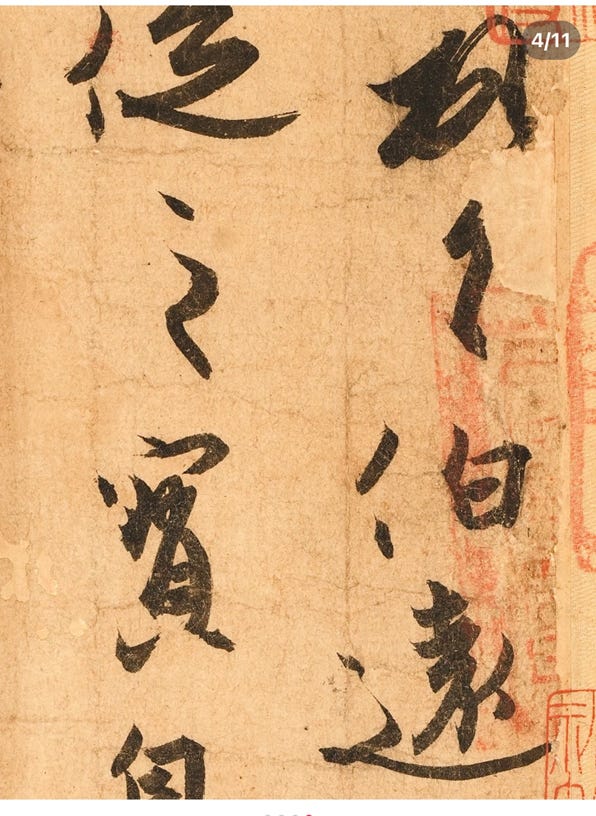
Third comes the aesthetic evidence. Are writing speeds uniform? Do directional turns show “pauses”? Can split-tip traces serve as badges of authenticity? We need to clarify a few basics. Running script is not a constant-speed movement. In truly high-antique writing, “swift and slow engender each other; haste and repose alternate.” Uniform speed is, in fact, a common symptom of the “palace hand” (馆阁体). To judge whether a “pause” is “hesitation in copying,” one must see where and how it occurs: if, at a node where the stroke must change direction (for example, horizontal turning vertical, vertical turning to a lift, or a circular return at the close), there is a brief “stored-force check,” that is a positive method of “using slowness to govern speed.” By contrast, when a “needless second remedy” appears along a long stroke that ought to proceed in one sweep, or when identical strokes show mechanically repeated checks, that more likely signals a copyist “finding the path.”
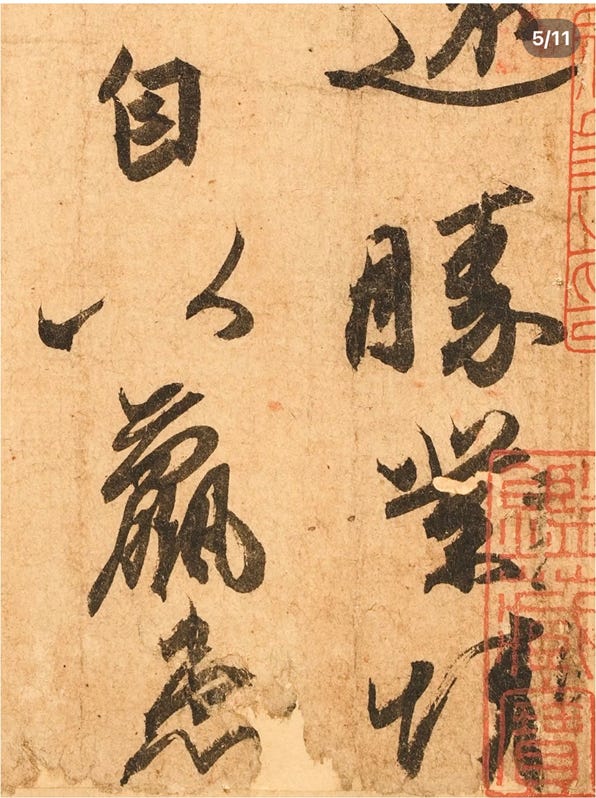
Take the often-cited characters bo (“伯”) and zi (“自”) in the Boyuan Tie. In “伯,” the left radical’s vertical descends slightly delayed, while at the right component’s horizontal-turn-hook there is a light check, followed by an inward pressing to take momentum; in “自,” the inner loop turns in a sequence that begins with reverse entry, continues with center-tip rotation, and ends with an outward expansion. These “slow points,” technically speaking, are not direct evidence of “copying hesitation”; they are exactly what one expects from the Jin method of “reverse entry—turning back the tip—exiting the stroke” (逆入—回锋—出锋). Viewed thus, the “uniform-speed theory” is unreliable. The “speed” of running script has never meant “an entire character dashed off in one go,” but rather “swift where swiftness is due, slow where slowness is due.” The Jin “speed” lies in the continuity of momentum; the Song “slowness,” in the clarity of method. The overall tenor of the Boyuan Tie is “an unbroken thread within strict method,” not a piece that “wins on sheer velocity.”
If we elevate “perfectly uniform speed across the whole” to a hard criterion, we will instead mistake the polished evenness of the palace hand for high antiquity and misread the Jin practice of “using slowness to command speed” as hesitation. The problem here is that certain similar components in this piece exhibit a “pause texture” that repeats too often (especially in the closing angles of certain vertical hooks and slanted lifts), and the repetition is similar in “force and duration.” In natural writing, the probability of such recurrence is very low; it appears frequently, however, in highly skilled copying that “seeks the shape to find the path.” In other words, “there are pauses” ≠ “it is a copy”; what is suspicious is the repetitiveness and mechanical nature of those pauses.
So-called “split tip” (破锋) is certainly not the exclusive preserve of autographs. Its mechanisms include “a rapid side-tip skimming that fans the hairs,” “a physical tearing caused by rough paper, low glue in the ink, or alternations of wet and dry,” and, quite often, the calligrapher’s deliberate risks taken through reverse entry and exit. Yes, split-tip appears in high-antique Jin traces, but to “determine authenticity by the mere presence or absence of split tip” is methodologically untenable. What we must observe is whether the split tip “arises for a reason and disappears with the momentum,” whether it links up with the intent of the strokes before and after into a “logically coherent chain of movement.” If the split tip looks like an “effect pasted on,” courting danger where one should not and forcing fei bai (飞白, “flying white”) where one should be restrained, it resembles “experiential camouflage.” In the Boyuan Tie, split-tip appears mainly at transitions “from side-tip returning to center-tip” and at edge strokes that “expand outward and then draw back.” On the whole, it “breaks without shattering; risk returns to rule,” which reads more like “a masterly written exemplar” than “affected imitation.”
Fourth, the technical evidence. Set the Boyuan Tie beside the widely acknowledged early and credible Tang copies of Jin models (for example, the Tang corpus of the Lanting [《兰亭》] and Yueyi Lun [《乐毅论》]) and one finds several shared traits: first, a line quality “center-tip as principal, side-tip as auxiliary,” an inner reserve of bone force that does not rely on overt angularity; second, a construction of “inward pressing and outward expansion” (内擫外拓)—a tight inner structure, a relaxed outer contour, strokes giving way to one another rather than colliding; third, a continuous current across the line of characters without stickiness, with “breathing points” (换气点) often occurring around the juncture where a horizontal passage ends and a vertical momentum begins. In all three respects, the Boyuan Tie aligns closely with the temperament of “high-precision writing/copying from the Tang to early Northern Song.”
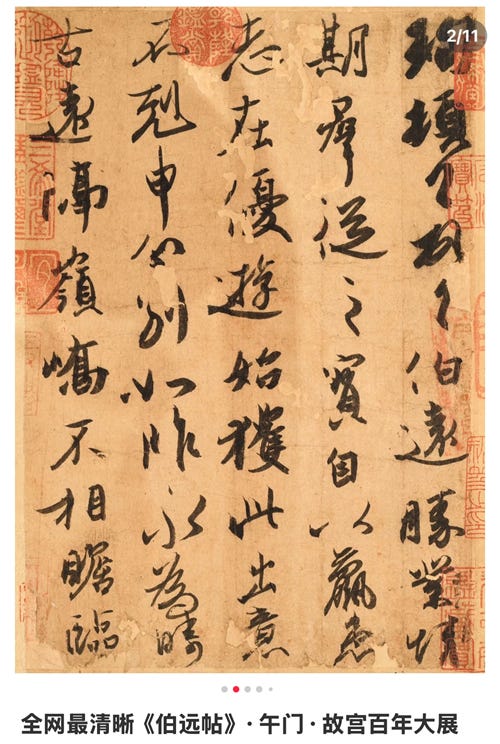
If we must choose between “a Jin autograph” and “a Tang–Song high exemplar,” I would tip the scales toward the latter: it is too refined, too steady, too “fit to be a model for later learners,” and does not read like an “occasional private letter dashed off in an original hand.” This is also what many connoisseurs, past and present, have repeatedly emphasized: what the imperial library preserved for courtly viewing and study was often “the most methodically reliable written exemplar,” not the “most idiosyncratic original jottings.”
Bringing the four lines together, my judgment is that we should not take the Boyuan Tie as a standard-answer “autograph by Wang Xun of the Eastern Jin.” Understanding it as “a highest-grade written/copy exemplar from the early Tang–Northern Song, made for imperial use and for study,” better accords with current evidence and with the common sense of calligraphic history. Here “copy/writing” does not mean dull tracing; it is “a re-creation completed within the same script lineage,” whose artistic density and methodological force far exceed those of ordinary “copying.”
In sum, even if the Boyuan Tie is not Wang Xun’s autograph, it is very likely the most superb “re-creation” of the Tang–Northern Song interval. Its “authenticity” may not be “at the level of authorship,” but it can almost certainly be affirmed “at the level of method” and “at the level of lineage.” For today’s practitioners, what truly merits close handling is how to write one’s own “bone and breath” between its “slow and swift,” its “steadiness and risk,” its “center-tip and side-tip.” Measured by that standard, when we look back at the “Three Rarities,” we need not be trapped by the binary of “autograph/non-autograph,” and can return to the very aim of calligraphy itself: to set up the bone with line, to shape the composition with momentum, and to school the mind with method.